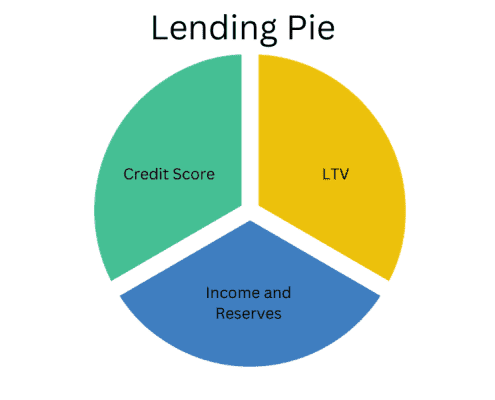
The Lender Pie: 3 Key Loan Qualifications in Real Estate

The biggest hurdle that many investors face is learning the lending side of real estate. Today we are going to go over the lender pie and how it affects you as an investor. For over 23 years I have been working with investors. Many of them are just starting out and learning how to build both income and wealth. Wealth in real estate investing is achieved by using other people’s money for leverage. It is important that you understand the leverage side, what it looks like, and how you can make it work for you. This will in turn allow you to better understand how to play the game and win in real estate. Let’s take a look at the three things that lenders are looking for when making their decision for approval.

All lenders are looking for three things that make up their decision if they are going to lend to you. This includes your credit score, LTV, and your income.

1. LTV 

LTV stands for the loan to value. It is determined by evaluating how much money you have in a property, how much equity you have, and what is your piece of this property. LTV is one of the biggest factors that lenders look at when determining if they are going to lend to you, how much they will lend, and what it is going to cost.  

2. Income and Reserves

Income and reserves can either come from you or from the property. If you’re looking at a DSCR or fix and flip, and you are going to sell it, then it is the income that the lenders will evaluate. Reserves include the amount of money you have put away in case something comes up. In regards to rental properties, it is how many months of reserves you have in case the property goes unrented for 3 to 6 months. If you’re a flipper, the reserves can help you make payments over the next 6 to 9 months until your property is sold.  

3. Credit score 

Lenders will evaluate your credit score and how you have paid people in the past before considering loan approval. Lending is primarily based on algorithms, and your credit score is a big determining factor. 

Which factor is the most important to lenders? 

The answer is that It’s always a mix between the credit score, LTV, and income. This is because everyone’s pie is just a little bit different when lenders are looking. Let’s take a look at a few examples and how one piece of the pie can impact the other two. 

Example 1: LTV

First let’s start by looking at LTV. The more money you have into the property the lower the LTV. This lower LTV allows the lender to be more flexible when it comes to your income requirements, or even your credit score. An example of this would be an individual who has owned a rental for a long time and is refinancing it with a 60% LTV. When your LTV is lower, they can overlook and maybe stretch the DTI or even lower the credit score requirements. On the other hand, if you have a property and you are into it for 90%, the lender will then be very diligent in making sure that you hit both the income and credit requirements. Remember if your LTV or credit score is not the perfect piece of the pie, then you may have to compensate for that with a higher rate. We want to make sure that you understand this so that you pay the least amount when you’re investing. Investing is all about creating more wealth and income by paying less on the money that you are borrowing.

Example 2: Income 

The question is, does your personal income make the payments, or can it make the payments on this new debt? The more income you have to cover the expenses, the more lenders can look at a higher LTV or they could even lower credit limitations. On the other side of it, if you have more reserves, the lenders can look at giving you a higher LTV. Just to clarify, reserves include 401K, IRA, stocks, bonds, and savings. Reserves are anything that is liquid. Let’s say your expenses are $1000 a month. This includes your mortgage, HOA, flood insurance, taxes, and insurance payment. If this property is bringing in $300K, the lenders will be a little more flexible on your credit and LTV because they know that this property is able to sustain. However, if the expenses are $1000 and you’re only bringing in $1100, then there is less of a cushion. The lender will see the income as being less sufficient to take any hits or damage if the property goes vacant for a month or the market shifts. They may want a lower LTV or require a higher credit score to help balance things out. 

Example 3: Credit score 

Your credit score is the most important factor in being approved or denied for a loan. If you have a good property, but a bad credit score in the 500’s, it won’t matter for most lenders. To clarify, a good property could be one that is 50% or 60% LTV. However, most lenders won’t even look at you. This is due to the fact that all lenders have guidelines and have to take into consideration certain things. If you have a 600 or even 620 credit score, then you are going to be limited. Your credit score is vital to your success. The higher credit score will get you more money, a higher LTV, and it will provide more flexibility on income requirements. It is imperative for new investors to get their credit score as high as possible because it will lower the interest rates, the lower the mortgage payment, and decrease the amount of income you will need.

In conclusion

These examples create a great picture of what real estate investors need to understand about leverage. Again, leverage is how you create wealth and income. Remember that it is not just one piece of the pie that is taken into consideration in the lending process. Instead, a lender is going to look at every piece and make sure that your pie is where it needs to be for approval. While LTV and income are more difficult to change, your credit score is a place where you can make the biggest impact. Be on the lookout for future videos that focus on credit and easy ways to raise your scores.

Our goal is to make sure that you are as successful as possible. Contact us to find out more about the lending pie and how you can raise your credit scores. 

Watch our most recent video about The Lender Pie: 3 Key Loan Qualifications in Real Estate to find out more.

by

How Much Money Do You Need for Peer to Peer Lending?

What is peer to peer lending and how much money do you need to get started? Peer to peer lending, also known as other people’s money, is funding that is provided by family, friends, or individuals within the community to help you in your investments. Here at The Cash Flow Company, we have done about a billion dollars over the past 23 years using peer to peer lending. To clarify, the majority of this money is not from family and friends, but instead from others interested in making a good return. Peer to peer lending is an excellent alternative to banks because there is little to nothing that you are required to pay. Let’s take a closer look at this excellent lending option and how it can help you with your financial needs. 

Who makes up the peer to peer lending community?

Peer to peer means that working with other people in the community who have just as big of a need as you do. In fact, these individuals might be in your church or individuals who are in retirement and need some extra income. They might have some money in a 401K, IRA, or extra savings that they would rather lend to you. Whether it’s 6%, 7%, or even 8% secured, it can help you with closing costs, while helping them get a better return on their money. 

Peer to peer is replacing banks.

We all know what is happening out there with affordability. The banks are starting to change their requirements, DSCR is getting into the 9% and 10% range, and fix and flip loans are anywhere between 11% and 13%. This lending squeeze is causing affordability, terms, and credit score requirements to all become tougher as well. Which creates the perfect opportunity to reintroduce peer to peer lending, and is something that has been around since before banking began. Peer to peer lending is taking out the banks and allowing people to begin working with humans again. 

Start the process and do it right.

If you are a good keeper of other people’s money, then it will expand. You have to start the process, do it correctly, and come up with a good package to present to them. What should you include in your package or portfolio? Let’s take a look.

  • What the property looks like
  • Estimate of what the rent will be
  • Include comps and additional research
  • Proper documentation 
  • Your plans for the property (rent or keep)
  • How the investment will be secured

Don’t take the cheapest path.

People try to take the cheap way out by not wanting to pay for the title, or record a deed because it’s going to cost money. The truth is, that all of those things are going to happen if you use a traditional lender. However, banks are going to charge more with higher interest rates. The better you make your peer to peer lender feel on the first few deals, the better the process will be in the future. It is imperative that you treat them like a real lender so that everything is official and secure. If it is done correctly, it will build a bridge that may bring more friends later on. Just to clarify, more friends does not mean adding more people onto a single note. Instead, these additional peer to peer lenders can be used separately for future investment opportunities. 

Something for everyone.

Every investor or business owner should look into peer to peer lending. Even if it is just for a down payment, fix up cost, or any other expense in the real estate world. Businesses could also benefit from peer to peer lending for start up costs or unexpected business expenses. It doesn’t have to be $500K, but it could be! With lending becoming tighter, banks could require an additional 10%. In that case, where would you go for the additional money? The answer is peer to peer! There are all kinds of people out there with pockets full of money. You just need to find one that has what you are needing.

Make the move today!

Peer to peer lending is an excellent alternative to banks for both investors and business owners! In many instances, there is little to nothing that you are required to pay in order to utilize these funds. If you want to find out more about peer to peer lending and how to get started reach out to us

We want to make sure that this market grows and that we get rid of some of the lenders and bankers out there. This will result in more money going into peoples accounts! The better it grows, the bigger it grows, and the more options people will have for their future. Ultimately our goal is to make it a win-win for both peer to peer borrowers and peer to peer lenders. 

Contact us today to find out more about the lowest risk lending option with the best return! 

Watch our most recent video explaining What is Peer to Peer Lending and Why You Need It

We have created an excellent resource site for you to discover more about peer to peer lending. This information can be found at www.TheNoteShop.com.

by

Breaking Down the Numbers: How Rates Impact Your Cash Flow

Today we are going to break down the numbers in order to paint a picture of how rates impact your cash flow. Specifically, we want to illustrate how rates, credit scores, and LTV can affect your ability to cash flow on a property. While we are aware that the Fed is impacting us, it is important that we see what that looks like on paper. The example we are reviewing today will provide an excellent visual of how everything plays a role in the real estate game. DSCR is the product we are using today because it is one of the most popular out there.

Type of property Purchase price Appraisal 

average 

rents in area 

Amount down Financing 

30 year loan

Fees

Taxes

Insurance

HOA

DSCR 

(LTV) 

Rental $250k $1,950 20% 80%

($200K loan) 

$300 75%
Credit Score DSCR rate Payment amount 

principle and interest

Payment amount plus fees  Cash flow 

based on appraisal 

Client 1 680 9.75% $1,718 $2,018 -$68.00
Client 2 720 8.99% $1,608 $1,908 +$42.00
Client 3 780 8.75% $1,573 $1,873 +77.00

What about Conventional and Fix and Flips?

This example is also representative of a conventional, and fix and flips as well. In a nutshell, the more you pay on interest, the less properties you can handle. 

What is the appraisal?

An appraisal determines the average of rents in the neighborhood and uses this amount in the underwriting. The amount can change depending on if you have a couple years of history with rents that exceed the determined amount. The increasing rates are making it extremely difficult for properties to hit the expected rent amount.

What is the DSCR rate?

DSCR rates are determined based on your LTV. A credit score below 680 typically lowers the LTV from 80% to 75%. Therefore, you would need to put in more money up front on each purchase. If you’re looking at a DSCR with a credit score of 679, you will either be declined or it will flip you into a non ratio DSCR. Which means that your rates are going to be higher. Is a DSCR loan right for you? Visit our website to find out more.

How do rates affect cash flow?

As rates continue to rise, your payments are going to increase as well. This in turn causes your cash flow to suffer, and in most cases it will be a negative. Cash flow positive on the other hand, means that there are going to be more properties available for more investors. So keep your eye out for this change!

In Conclusion.

It is vital that you understand how rates, credit scores, and LTV can all affect your ability to cash flow on a property. Today we painted a picture that provided a side by side comparison of 3 different people. This allowed us to illustrate how all of these components work together and impact the overall cash flow. Let today’s example empower you to take a closer look at your numbers in order to create more cash flow in 2024!

Check out our website to find ways to positively impact your credit, as well as a weekly newsletter. We are here to help you get on the path to success. 

Watch our most recent video to find out more on How High Interest Rates Impact Real Estate Investments.

by

Leveraging Bargain Properties for Maximum Gains

Real estate is all about creating leverage. Another way to create that leverage is to buy undervalued properties. What exactly is an undervalued property? It is a property that is being sold for less than it is worth. These are the properties that provide an opportunity for you to receive 100% financing and steady income for the rest of your life. Let’s take a look at a few examples of how an undervalued property can help you to succeed. 

Hoarders helper

Just the other day a friend of mine helped someone move out of a hoarder house that was under foreclosure. The homeowners no longer wanted the property, and they just couldn’t get everything done in time. My friend was able to come in and give them some money to take care of things, allowing the homeowners to get out of the property.. My friend was able to get the house at 70% of the value and put in 10%. In doing so, he created 20% net worth for himself. With the condo appraisal for $250K, he created $50K in wealth within just one weekend. 

Starting with nothing

Another local guy we know sold his car in order to get his first real estate deal. Fast forward 4 years, he has built three 6 unit apartment buildings with cash. These properties are owned free and clear, which is creating a steady income for him for the rest of his life. He achieved this success by being very diligent with both his process and his numbers. This is a prime example of how people who put their mind into something, can in turn create the wealth that they want. 

Lenders like undervalued properties

Lenders consider undervalued properties to be safe. This is because they are such a good deal compared to other properties on the market. Therefore, real estate investors can often get 100% financing on a property that is under market value. There are a lot of properties that are well under market value out there and many of them need some work. By taking the time and fixing them up correctly, you could guarantee a future profit for your investment.

Buy undervalued properties for maxim gains

Real estate is all about leverage. By leveraging bargain properties, you will in turn have maximum gains on your investment. It doesn’t take a PhD or a masters, it just takes some Doers! These are people who want to get out there and just do it. Investors who go through the correct steps can in turn make great returns within a short period of time. Some people want to make $50K to 80K in a year and have 6 months off. That is the beauty of investing and leveraging correctly. 

Watch our most recent video to find out more about Leveraging Bargain Properties for Maximum Gains.

Contact us to find out more about the importance of leverage and how to fill up your money buckets.

by

What is Peer to Peer Lending and Why You Need It

What exactly is peer to peer lending and why do investors need it? Peer to peer lending, also known as other people’s money, is funding that is provided by family, friends, or individuals within the community to help you in your investments. Here at The Cash Flow Company, we have done about a billion dollars over the past 23 years using peer to peer lending. The majority of this money is not from family and friends, but instead from other people who are interested in making a good return. Investors and business owners are looking for other sources for their financial needs, which is where peer to peer lending can be an excellent alternative to traditional bank loans.

Who makes up the peer to peer lending community?

Peer to peer means that working with other people in the community who have just as big of a need as you do. These individuals might be in your church or individuals who are in retirement and need some extra income. They might have some money in a 401K, IRA, or extra savings that they would rather lend to you. Whether it’s 6%, 7%, or even 8% secured, it can help you with closing costs, while helping them get a better return on their money. 

Peer to peer is replacing banks.

We all know what is happening out there with affordability. The banks are starting to change their requirements, DSCR is getting into the 9% and 10% range, and fix and flip loans are anywhere between 11% and 13%. This lending squeeze is causing affordability, terms, and credit score requirements to all become tougher as well. Which creates the perfect opportunity to reintroduce peer to peer lending, which is something that has been around since before banking began. Peer to peer lending is taking out the banks and allowing people to begin working with humans again. 

Peer to peer gets deals done quickly.

Every good investor always has a few peer to peer lenders that they work with on a regular basis. These are individuals that the investors have built a good reputation with, and proved that they can produce quality work. By creating this foundation, it allows investors to act quickly on deals that come available instead of waiting for the bank’s approval. Peer to peer lenders also benefit because they are able to use money from their savings accounts or retirement accounts in order to get a better return that is something secured. It’s a great win-win situation for everyone!

Something for everyone.

Every investor or business owner should look into peer to peer lending. Even if it is just for a down payment, fix up cost, or any other expense in the real estate world. Businesses could also benefit from peer to peer lending for start up costs or unexpected business expenses. It doesn’t have to be $500K, but it could be! With lending becoming tighter, banks could require an additional 10%. In that case, where would you go for the additional money? The answer is peer to peer! There are all kinds of people out there with pockets full of money. You just need to find one that has what you are needing.

No need to make things awkward

Again, peer to peer lending is funding that is provided by family, friends, or individuals within the community to help you in your investments. While we all know that borrowing money can create an uncomfortable situation, there are three steps you should follow to prevent this from occurring.

  • Make sure you are putting them in good deals both now and in the future. 

These are deals that have a good chance of cash flowing. This can be done by making sure you have a good ARV or After Repair Value before jumping into a deal. 

  • Make sure you do the proper paperwork. 

Proper paperwork  includes a real note, a mortgage, or a deed of trust that’s secured on a property. If you do it right and secure it with real estate, then they are in a good position as a lender.

  • Get out there and mingle.

You need to get out there and talk to real estate groups.  Find out what they are doing, and who they are using for their peer to peer lenders. There are a ton of people who want to get into real estate, but they don’t want to get into the real estate game. Instead they just want a better return.

Start the process and do it right.

If you are a good keeper of other people’s money, then it will expand. You have to start the process, do it correctly, and come up with a good package to present to them. What should you include in your package or portfolio? Let’s take a look.

  • What the property looks like
  • Estimate of what the rent will be
  • Include comps and additional research
  • Proper documentation 
  • Your plans for the property (rent or keep)
  • How the investment will be secured

Don’t take the cheapest path.

People try to take the cheap way out by not wanting to pay for the title, or record a deed because it’s going to cost money. The truth is, that all of those things are going to happen if you use a traditional lender. However, banks are going to charge more with higher interest rates. The better you make your peer to peer lender feel on the first few deals, the better the process will be in the future. It is imperative that you treat them like a real lender so that everything is official and secure. If it is done correctly, it will build a bridge that may bring more friends later on. Just to clarify, more friends does not mean adding more people onto a single note. Instead, these additional peer to peer lenders can be used separately for future investment opportunities. 

Peer to peer keeps things simple.

We want to keep it simple and find the people that fit your needs. Not everyone needs $300K or $500K. They might just need $35K or $50K to get their business going. While they do have real estate to secure a loan, they might not have the income that the bank requires. That is where peer to peer lending comes in. Most peer to peer lenders don’t care what your income is. They want to know what the property looks like, if it will protect their money, and what you are going to pay them. Another way to look at peer to peer lending is like a personal DSCR. A DSCR doesn’t care about your income either. With the high interest rates of DSCR in this market, peer to peer lending is a comparable option for investors with rental properties.

Double your money!

Peer to peer is so important for those who are lending. They can easily make $8K on $100K. Banks on the other hand, would only have a return of $4K to $5K on the same amount if it were in a CD or savings account. Peer to peer lenders could easily double what they are making without having to worry about the inconsistency of the stock market. This is a time when things are tightening and people are having to look for new opportunities. Those who are prepared, ready, and have money, will succeed. 

Where do you start? We can help!

If you want to find out more about peer to peer lending and how to get started reach out to us. We have developed methods for both borrowers and lenders that will walk you through the process of getting started. We want to make sure that this market grows and that we get rid of some of the lenders and bankers out there. This will result in more money going into peoples accounts! The better it grows, the bigger it grows, and the more options people will have for their future. Our target is to make it a win-win for both peer to peer borrowers and peer to peer lenders. 

Contact us today to find out more about the lowest risk lending option with the best return! 

Watch our most recent video explaining What is Peer to Peer Lending and Why You Need It

We have created an excellent resource site for you to discover more about peer to peer lending. This information can be found at www.TheNoteShop.com.

by

What Rates Should Investors Expect in 2024?

Now is the time to look at what rates investors should expect in 2024! I have been in finance a little over 35 years, and working with real estate investors for 24 years. While experience isn’t exactly a crystal ball, it does help guide investment decisions and identify market trends. We saw real estate predictions come to live in October of 2023 when rates did improve. As we begin to prepare for 2024, it is important that we follow the trends from Fannie Mae, NAR, and the Mortgage Brokers Association. Let’s take a closer look at the trends and what they mean to real estate investors.

What are some things to look for in 2024?

First and foremost we are going to see a more stable market. Let’s start by taking a look at Fannie Mae and focusing on the conventional rates specifically. Conventional includes people who are buying properties, flippers, and those who are refinancing a rental property. Fannie Mae predicts that rates will be between 7% and 7.6%. NAR on the other hand is more optimistic and anticipating rates to fall between 6% and 7%. We have already seen a shift and are hopeful that the rates will continue to follow this pattern! 

What about the Fed?

Nowadays the Fed is saying that they think inflation is under control, and in turn they are going to stop raising rates. However, this doesn’t always mean that it reflects 1:1 in the real estate world. In an investor’s world, there are all kinds of loans, which are all affected by different economic conditions. Rates will be better, but they will be volatile. This means that there will be months when rates are up, and months when rates are down. It is dependent on economic information, wars around the world, and the possible impact of 2024 being an election year.

Will rates ever go back down to 5%

In looking back at rates in 2023, we did see them pop up over 8%. However, real estate investors are optimistic that rates will go back down to 5% in the New Year. Many are asking when can we expect the rates to decrease? The decrease will continue to be seen in the conventional rates, which are tied to the 10 year treasury. What is the 10 year treasury? It is a bond issued by the United State Government that guarantees repayment of the money plus interest in 10 years. Even though the Fed dropped their rates and then raised them, the 2024 interest rate prediction is that rates will drop again in May. While they may not go down to 1:1, investors will see a significant decrease. 

In conclusion.

2024 expected rates indicate that real estate investors will see a decrease in the upcoming year. This will create more affordability and financing for buyers, as well as an opportunity for investors to sell some of their inventory. As rates go down, it will create wealth, income, and more opportunities. While we don’t have a crystal ball to predict the future, we can utilize trends and  experiences to guide us towards success. 

Here at The Cash Flow Company we have created a weekly mortgage report to keep you up to date on current changes and trends. 

Email us at info@thecashflowcompany.com to receive the weekly mortgage report updates or look for it on our website at www.thecashflowcompnay.com

Watch our most recent video to find out more about 2024 Interest Rate Predictions and the Investor Mortgage Report


by

There is Hope in a Tough Housing Market

Things have changed, bankers have changed, and lenders have changed. You should always have control over your lending options. There is a glimmer of hope in this tough housing market. Investors can empower themselves by setting things up right, cultivating relationships, and knowing their numbers. You can still make a lot of money in this market as long as you understand the rules in the game and have the flexibility to change with the times. How do you get started? Let’s take a closer look at what you need to do to succeed.

What do investors need to do?

This is the time when the select few will make a lot in the near future. If you want to take advantage of this, then you have to do certain things. Let’s take a closer look at real estate investment essentials for today’s market. Also known as the pillars of success.

1. Find a lot of properties/find good properties

It is important to buy when everyone else is running away. A successful investor needs to determine where they will find properties, connect with others to start buying better properties, and understand the value of the property. The better the property you find, the better chance you have to get the financing you need. Especially from private lenders or hard money lenders. 

2. Set up your business correctly  

It is imperative that you set up your business to look like you are serious about investing. This includes setting up your business name, establishing business accounts, and applying for business credit cards. In setting these things up correctly, banks and lenders will know that you will do what it takes to succeed.

3. Make sure you have a diverse source of funding 

Start by looking for lenders who are actually lending, and build a relationship with them. In taking the time to build that foundation, you will be the person who goes to the top of the pile. Lenders will not be willing to help investors who don’t return calls, or those who are unprofessional. Finally, broaden your horizons by looking at other options to see who can help create the wealth you want. 

4. Find contractors and resources that will help you complete repairs.

We still see properties that are selling like crazy. These are in good locations and have quality work done. It is important to find contractors and resources that will help create a product that people will want to buy. Don’t skip on the flips! Take the time to find a team who can make your property shine. This will result in a shorter sell at a better return for you.

Creating the leverage you need to succeed.

Make sure that your business is set up correctly from the very beginning in order to create wealth. In doing so, you will be able to open up business credit cards, business lines of credit, and seek out OPM or other people’s money. An underused source of funding is OPM. Nowadays more people are searching for better returns, you can be their solution. Investors who create these buckets of money will set themselves up to win. It is also imperative that you have a good credit score and a good business history so you will be more attractive to the lending community. Do you need help with raising your credit score or locating OPM. Contact us to find out more! 

In Conclusion

There is a glimmer of hope in this more restrictive economic environment. Those who set things up correctly in the beginning will have an advantage over those who do not. It is important to always remain in control amongst all of this change. By setting your business up correctly, increasing leverage, doing research, and creating relationships, the sky’s the limit for your success. This is one of the most valuable times to get into real estate investing! Contact us to find out more.

At The Cash Flow Company we can help you find the funding you need and guide you through this market. 

Watch our most recent video to find out more about Real Estate Investment Essentials for Today’s Market.


by

Key to Succeeding in Today’s Real Estate Market

The key to succeeding in today’s real estate market is consistency. If you are consistently looking at properties, finding lenders, and doing things correctly, then you will set yourself up for success. Things have changed dramatically compared to 10 to 12 years ago. Back then, there was a whole generation of investors who had an easier time navigating the market. They had lower rates, property values increasing, and lenders were throwing money at everyone. Nowadays, everything is tightening up. Lenders are disappearing, and those who are still lending are becoming more selective. It is imperative that investors stand out in this market and set themselves up correctly. In doing so, investors will get the best deals and set themselves up to win. 

How the market works

When interest rates go up, people can no longer afford to buy properties. The decrease in home sales results in a plateau or even a decrease in property values. Predictions are saying that rates will go back down to 5.5% in 18 months time. When they do, people will once again be able to afford to buy properties. As things loosen things up, there will be a wave of people coming into the market and buying properties. Investors who set themselves up in this market will win in the future.

Let’s look at an example

A property that you purchased a few years ago for $400K would now sell for $350K in this current market. When the wave comes back in 18 months to two years, that same property will be selling for $450 to $500K! That’s a great return. During these cycles, many people start running away and stop buying properties. These are the times when smart investors come in and buy. If they are able to hold onto it until rates improve, then they will in turn reap the benefits of the better rates and generate greater cash flow.

Customer success story

In 2010 I helped someone buy 10 homes in a year, without him putting any money in. Back then, the properties were cash flowing $500 per month because he had bought them at such good numbers. Fast forward to 2022. He only owes on 3 of the properties and has paid off the other 7. They have all increased in both the property value and rent by 3x and even 4x on a few of the homes. In only one year he set himself up for the rest of his life. This is all because he bought when everyone else was running away. 

In conclusion

Remember that consistency is the key to succeeding in this market. From finding properties, to locating lenders, and setting things up correctly, consistency will create success. This is the best market to get deals in. When rates go back down, which they will, it will create a wave of people coming into the market and buying properties. Now is the time to get ahead of the wave of success. In doing so, you will be able to take advantage of lower rates, increase your property value, and most importantly create cash flow.

Contact us today to find out more about the changing times and what you need to do to get ahead of the wave.

Watch our most recent video to find out more about the Key to Succeeding in Today’s Real Estate Market

by

How High Interest Rates Impact Real Estate Investments

Today we are going to paint a picture of how high interest rates impact investments for those who fix and flip properties or have rentals. Our goal is to show how rates, credit scores, and LTV can affect your ability to not only qualify for a loan, but also cash flow on the property. We all know what is happening with the Fed and how it is impacting us, but what does that look like on paper? The example that we are reviewing today will provide an excellent visual of how everything plays a role in the real estate game. DSCR is the product we are using today because it is one of the most popular out there.

Type of property Purchase price Appraisal 

average 

rents in area 

Amount down Financing 

30 year loan

Fees

Taxes

Insurance

HOA

DSCR 

(LTV) 

Rental $250k $1,950 20% 80%

($200K loan) 

$300 75%
Credit Score DSCR rate Payment amount 

principle and interest

Payment amount plus fees  Cash flow 

based on appraisal 

Client 1 680 9.75% $1,718 $2,018 -$68.00
Client 2 720 8.99% $1,608 $1,908 +$42.00
Client 3 780 8.75% $1,573 $1,873 +77.00

What about Conventional and Fix and Flips?

This example is also representative of a conventional, and fix and flips as well. In a nutshell, the more you pay on interest, the less properties you can handle. 

What is the appraisal?

An appraisal determines the average of rents in the neighborhood and uses this amount in the underwriting. The amount can change depending on if you have a couple years of history with rents that exceed the determined amount. The increasing rates are making it extremely difficult for properties to hit the expected rent amount.

What is the DSCR rate?

DSCR rates are determined based on your LTV. A credit score below 680 typically lowers the LTV from 80% to 75%. Therefore, you would need to put in more money up front on each purchase. If you’re looking at a DSCR with a credit score of 679, you will either be declined or it will flip you into a non ratio DSCR. Which means that your rates are going to be higher. Is a DSCR loan right for you? Visit our website to find out more.

The power of credit scores.

Your credit scores not only affect your rates, but they also will impact your cash flow on the property. Do you need to raise your credit score in order to qualify? We can help you get your credit scores back on track with our 911 loan. Contact us today to find out more. As credit scores go up, you will be able to capture more monthly income and create wealth.

How do rates affect cash flow?

As rates continue to rise, your payments are going to increase as well. This in turn causes your cash flow to suffer, and in most cases it will be a negative. Cash flow positive on the other hand, means that there are going to be more properties available for more investors. So keep your eye out for this change!

Rates are decreasing!

Over the past three weeks rates have been decreasing. We may be at the peak right now and many are predicting that rates are going to significantly drop in 2024. It is imperative that you stay up to date and keep track of current trends. We have created a Weekly Investor Mortgage Report for you! Reach out through our website or email to find out more.

Keep increasing your leverage!

In real estate investing leverage is the key to success. It is what makes your wealth and creates your income. By using banks, other people’s money, and filling your leverage buckets, you will set yourself up for success.  

In Conclusion.

I wanted to paint this picture so you can understand how 3 different people compare side by side on the same property. Investors can either be denied or approved just based on their credit score, or where the markets are. While being denied is discouraging, it is important that you understand why you didn’t qualify and why properties are not cash flowing right now. If you want to impact where you are and where you are going in the New Year, then check out our website. We have a lot of ways to positively impact your credit, as well as a weekly newsletter. We are here to help you get on the path to success. 

Watch our most recent video to find out more on How High Interest Rates Impact Real Estate Investments.

by

Why You Should Buy Rental Properties Now

Investors are asking why they should buy rental properties with interest rates being so high. While no one has a crystal ball to see the future of interest rates, there is a market trend that many seasoned investors follow. They buy when rates are high, and then refinance when the rates drop again. In doing so, the seasoned investors put themselves ahead of the game. Consequently, by already having a property in hand, it takes the pressure off not having to rush into deals when rates drop. You too will be able to take advantage of the lower rates without scrambling to find properties. Below is an example of how cash flow is being affected by the current interest rates. Our focus is on the future. The ultimate goal is to buy now in order to create optimum cash flow later. 

DSCR Loan

Today we are going to dive into an example illustrating why purchasing rental properties now will increase your cash flow in just a few years when using a DSCR loan. What is a DSCR loan? A DSCR loan are loans focused on the rents from a rental property and the credit worthiness of the borrower. While the increasing interest rates are making it harder for investors to qualify for a DSCR loan, those who are able to find good properties will in turn set themselves up for success when rates go back down.  

Example:

$250K DSCR Loan 
Time Frame Percentage Expected Payment Change Over Time
Couple years ago 3.75% $1,158
Now 9% to 11% 

(depending on LTV)

$2,011 $853 

Payment Increase 

In the Future 7% 

(you refinance $2,011 principle)

$1,663 $348

Cash flow increase 

The Optimus  5%

(Looking if it dropped from 9% to 5%)

$1,342 $669 

Cash flow increase 

What is a “good property” to buy now?

My suggestion for investors is that they need to find something that has good equity and at 25% to 30%. As long as it is breaking even, then in a year or two when rates go back down, you will be able to refinance to increase your cash flow without buying another property. The more affordable the homes are, the bigger the market becomes. The good news is that buyers are going to start buying again, and the values around you are going to increase. While no one can predict that the interest rates will go back down to 2.5% for owner occupied and 3.75% for investors, there are indications that interest rates will drop in 2024. 

What else can you do to succeed in this market?

You’re not alone! There are a lot of people who are questioning if they should buy now. Navigating this market can be overwhelming for many investors. By doing your research and investing wisely, you will not only increase cash flow, but create generational wealth as well. I will be doing a follow up video that will further show you the effect that interest rates have on cash flow. This will include a look from the buyers side, and how the market is going to push up your values. 

Watch our most recent video about why rental properties fail to cash flow and how you can set yourself up for success by investing now.

Do you have questions about DSCR loans or how you can create generational wealth? Contact us today!


by