Making your real estate business plan Easy, Lucrative, Fun, and FAST is a critical component to your success as an investor!

A while ago, Joe Polish from I Love Marketing began using the acronym “E.L.F.” to describe an easy, lucrative, and fun business.

However, in the real estate world, time is everything. While we totally support easy, lucrative, and fun real estate investing, we also recognize that we need to move FAST.

How Do You Set Yourself Up to Win?

You need to learn to play the leverage game. Leverage (using other people’s money in the form of loans and gifts) is what makes real estate investing lucrative and accessible. Having the right leverage when you need it can really make or break your business.

And the truth is this:

Leverage is significantly affected by your credit score.

One of the first steps in your real estate business plan ought to be checking out your credit score.

1. Switch to business credit cards.

We’ve talked previously about the importance of not using personal credit cards for business-level investing. 

Most personal credit cards simply are not designed for the level of usage needed in the real estate investing business. Because of the quantity of purchasing necessary for most fix-and-flips, you may want to look into business cards that have higher usage limits.

2. Consider a usage loan.

Additionally, if you are in a situation where your credit score is negatively affected by high usage, don’t worry. You can look into a usage loan.

We offer them here at The Cash Flow Company, or you can check out our partner company Hard Money Mike

3. Understand the need for speed.

A good credit score can dramatically speed up the investment process.

Leverage makes real estate investing an even playing field for everyone out there, but credit scores can limit your leverage if you’re not careful. 

A good credit score opens doors and makes everything cheaper, easier, faster. 

To E.L.F.F. the real estate business, you need to set yourself up to win.


Read the full article here.

Watch the full video here:

by

How Real Estate Investors Can Prepare for Bank Collapse

How can real estate investors prepare for the collapse of banks? What does that mean for them, and what does that mean for you as a real estate investor? We will coach you through this lending squeeze by not only looking at the challenges, but also highlighting lending alternatives that will help you stay afloat.

In the lending community, banks are experiencing a decrease of money flowing into the lending pool. Over 190 banks have been placed on the watch list because funds are leaving the bank at an accelerated pace. What does this mean for investors specifically?

There are three main ways this problem is impacting real estate investors today. Let’s dive in and discover more!

Changes to the Banks’ Lending Pool

1. Banks are Lending Less

Unfortunately, with the lending restrictions, banks are being forced to swim upstream in search of the “best of the best clients.” What makes up a perfect client? It’s those who have more cash in the bank, more revenue, and better credit scores. However, those specifications don’t always fit the majority of investors. 

2. Book of Debt

To put it briefly, savings accounts and CD’s that were booked years ago at low percentages are increasing dramatically. What started at a monthly profit of 3% to 4%, has become a deficit of 5% to 5.25%. This situation is forcing investors to sell bonds and get rid of old debt, so they are longer upside down on past assets.

3. Book of Business

Banks who wrote notes to businesses 3 to 5 years ago are now coming due. What started as 3%- 4% interest rates, has skyrocketed to 8%-10%. Unfortunately, because of this, many businesses can no longer qualify. What do banks do when notes become nonperforming? The government requires banks to put in more capital to help cover potential losses. Lending is not in the forefront of banks minds in the traditional sense. The primary option for investors is SBA loans, which are backed by the government, and therefore they do not have the same lending restrictions.  

Investors are Searching for New Lenders:

Why are they looking for new lenders? Investors are forced to explore uncharted waters to locate private lenders because banks are focused on the “best of the best.” This waterfall effect is forcing investors to cascade down to private lenders to keep their businesses afloat. With the influx of new clients, private lenders are also swimming upstream alongside banks, searching for borrowers with more experience, more money down, and more liquidity. Lenders who used to lend 75% ARV are now lending 75% LTV. This could result in investors spending 20%-30% more on each deal if you’re even able to qualify. 

Additional Aspect for Fix and Flip Properties

In regard to fix and flip properties, investors need to consider the current interest rates for homes. When rates go up, the ability for a buyer to buy a house goes down. In just two years’ time, a house for $295,000 in 2021 is now $500,000. The affordability of properties has stretched what investors can fit into their budget, and what they are able to qualify for depending on the DTI (debt to income). 

Managing the Lending Squeeze

How real estate investors prepare can will result in success when navigating these rough seas. The goal is to make sure you have cash, high credit scores, and that you are keeping up on projects.  Get into a deal now and hold it for 2-3 years to set yourself up for success.

Open your eyes to additional lending sources, such as “other people’s money” aka OPM, to fund part or even all of your projects. These are individuals within our community that can lend anywhere from $10,000 to $100,000. They are out there! It’s just a matter of knowing where to look and who to ask.

Money and credit are going to be your keys to making sure that you are in the game as the rates continue to increase. We can help guide you through the process of starting your business, increasing your credit scores, finding ways to improve your income, and helping with OPM options.

Need more help navigating these rough waters watch our most recent video!

We’ve raised millions of millions of dollars over the past 15 years by bringing in money from other investors who are just looking for a return. If you need coaching or help taking advantage of these opportunities give us a call! 

by

When the real estate market tightens up, you need to be prepared with leverage so you can take advantage of investing opportunities.

Once you’ve been in the business for as long as we have, you start noticing patterns. The investing world goes through cycles every few years where things tighten up before flowing normally again. 

However, a ‘bad market’ doesn’t necessarily mean bad news. 

If you’ve prepared beforehand, you can actually take advantage of the challenging landscape to build some wealth.

What is a ‘Bad Real Estate Market’?

Essentially, what’s happening right now is banks are tightening up. This means most are lending out less money, making it harder for investors to get the money they need.

This also means that, over the next 6-9 months, people are going to be getting rid of some properties and fewer people will be buying.

If this sounds like bad news, don’t worry. If you’re ready for these market changes, it can actually be the perfect time for you to buy. 

Filling Your Money Buckets

Since there’s going to be fewer loans coming out of banks, what can you do to make sure your finances are prepared for the shift in funding?

For every project, there is an amount of money that goes into it. We call it a bucket of money, or, your money bucket

Your money buckets needs to cover purchase, rehab, closing costs, etc. Part of that money bucket comes from lenders, and part of it comes from you

If you’re a newer investor, don’t panic! Read on to learn how to fill those buckets.

3 Key Strategies For Better Loans in a Bad Real Estate Market

Our goal is to help you figure out how you can get more money from lenders so less is coming out of your pocket.

1. Get Your Credit Score in Line

In the past, 660-680 used to qualify you for an okay loan. Not anymore! As lenders tighten up, most will be looking for scores closer to 750-799+. 

Lenders are depending more and more on credit scores. Make sure your credit score isn’t holding you back!

If you’re using personal credit cards for your investing projects (using them to buy supplies, pay vendors, etc.) stop now

Personal credit cards aren’t made for that level of usage, and most cards will drop your credit score if you’re using too much of your balance on a regular basis.

This can lead to a significant usage issue. There are two things you can do to help fix this problem:

Once you raise your credit score, make sure you maintain it. Since lenders look so closely at your score, you should too!

2. Fill Your Bucket With More Money

If you’re new to real estate investing, this is often the hardest part. However, there are many ways you can work to fill your money bucket without needing to drain your personal bank account.

Obviously your lines of credit can be an asset to your money bucket, but Other People’s Money (OPM) is also important.

Ask around your friends, neighbors, family members, or investment clubs. Many of them could be interested in investing a few thousand dollars into a project with a secured return of 8-10%.

There are so many creative ways to help fill your money bucket from hard money, to lines of credit, to OPM. With more money in your bucket, you can do more transactions.

If you need help filling your personal money bucket, reach out to us. We’ve coached many new investors through this process.

3. Be Picky With Your Deals

Don’t feel rushed. Be selective.

As you shop around for investment properties, look for ones that are under a 70% After Repair Value (ARV). 

This is a good time to be picky, especially if you’re new to the game. Choose safe deals that will guarantee you a solid return when the market heats up again.

If you do it right, finding the deals that are 70% ARV or below can open up many more deals and transactions in the future.

In five years, when everything is back to normal, those properties are going to have great value and you could create significant wealth.

We’re Here to Help You Navigate This Real Estate Market!

If you take the time to get your credit score and money buckets in order now, you set yourself up well to move quickly when you do find the right deals for you. 

If you need help figuring out where to start or you want to discuss loans or investment strategies, reach out to us at Info@TheCashFlowCompany.com or fill out a contact card.

We also have many free tools and resources that you can check out. Our goal is to help you feel equipped as you enter your investment journey, and we are always happy to help.
by

The First Steps to Setting Up Your Business

Today we are going to discuss the first steps to setting up your business. Whether you’re dreaming of flipping houses, building rental property portfolios, or simply exploring the vast opportunities in real estate, starting strong is crucial. Setting it up correctly from the beginning can make all the difference in how lenders and partners view you, and ultimately, in your success. Let’s get started! 

First: Choose a Name

  • Search for Availability: Immediately start by checking with your state to ensure the name is available.
  • Avoid Real Estate Specific Names: More importantly, opt for a generic name like “John Smith Consulting” instead of “John Smith Fix and Flip.”

Second: Obtain an EIN (Employer Identification Number)

  • Apply with the IRS: The EIN is actually a social security number for your business. It’s essential for not only tax purposes, but even for opening a bank account.

Third: Set Up a Business Bank Account

  • Separate Finances: Immediately separate business finances from personal finances. Keep your business and personal finances separate in order to make things clear for lenders.
  • Use Your EIN: Again, this is required to open a business bank account.

Forth: Establish Your Business Presence

  • Create a Website: By creating a simple website, it can show lenders as well as partners that you’re serious.
  • Get an Office Address: To clarify, even a virtual office can help establish credibility.

Setting Yourself Up to Win

  • Think Long-Term: By setting things up correctly from the start it makes future growth easier.
  • Be Realistic: Understand that while the process takes effort, it will easier over time as you build experience as well as a network.

Summary

By following these steps and staying committed, you’ll be well on your way to building your successful future. Remember, the key is to set up your foundation correctly and maintain consistent effort. Contact us today to find out more! 

Watch our most recent video: The First Steps to Setting Up Your Business 

by

What do you need to know about your credit score and money bucket so your investing is easy, lucrative, fun, and fast?

We want to give you the tools you need to win in the real estate game. 

In a recent article, we learned how lenders look at your credit score to determine the maximum loan they’ll offer. Today, we want to apply the same principles specifically to DSCR loans.

Some investors focus on fixing and flipping properties, while others create wealth through rentals. DSCR loans are one of the most useful tools for investors that are specifically designed for rental properties.

Understanding Leverage

Leverage is what we call using other people’s money. This typically comes in the form of bank loans, but it’s not limited to that.

Things like financial gifts, small loans from friends and family, your credit score, and loans from companies like Hard Money Mike can all give you leverage.

This leverage creates an equal playing field in the investing world. You don’t need to be wealthy to use leverage well.

Credit Score as Leverage

In this day and age, credit scores matter a lot. A good credit score is a powerful tool that you can use to increase your leverage.

We also sometimes talk about money buckets. Your ‘money bucket’ is the money you bring to the table. Obviously, if you’re a newer investor, your money bucket might not have as much personal money to fill it, in which case credit score matters even more.

However, strategically using your credit score, credit cards, business cards, HELOCs, etc. to fill your money bucket now is a great way to make sure you’re ready for future investing.

How to Fix a Bad Credit Score

If you have a low score, it’s typically because of 1) late payments, or 2) usage. Unfortunately, there are no quick fixes for late payments. However, if you struggle with usage issue, there are a few things you can do.

First of all, a usage issue typically happens when you’re using too high of a percentage of your monthly allowance. This means that, even though they paid off their balance on time every month, excessive use of a personal credit card can driving down your score.

Here’s the deal: personal credit cards are not built to handle consistent real estate investing expenses. If you’re doing consistent real estate investing, we recommend looking into business credit cards.

Business cards often have higher usage limits which are ideal for the constant wear and tear of this industry.

You can also look into secured usage loans as a way to quickly boost your credit score.

Main Money Bucket Takeaways

Leverage is king, and credit scores are an important piece of your leverage.

A good credit score makes it easier for you to qualify for and refinance your DSCRs. They can also help you put less money down on a property and increase your cash flow. 

Take care of your money buckets and credit score on the front end so you can succeed when deals come your way.

To help you get prepared, you can explore our website where we have free tools you can download to help you get organized, including a DSCR calculator and a business credit card marketplace.

If you’re interested in learning more about how you can E.L.F.F. your investing, feel free to reach out to us at Info@TheCashFlowCompany.com or fill out a contact card.


Read the full article here.

Watch the full video here:

by

DSCR Loans: Does Your Rent Cover Your Costs?

Today we are going to discuss the importance of asking “does your rent cover costs” when considering a DSCR loan. Getting a DSCR loan can be both easy as well as rewarding. Let’s take a closer look! 

First and Foremost: Check Your Rent Coverage

First, ask yourself: does your rent cover all your costs? This includes:

  • Mortgage payment
  • Taxes
  • Insurance
  • HOA fees

While it’s not always necessary, by having your rent cover these costs can in turn help you get better rates as well as higher loan-to-value products. At the very least, aim to charge rent that covers your monthly payments. However, if it does, then you’ve passed the first step!

Example: Begin by imaging that you own a rental property. Your mortgage payment is $1,200, your taxes and insurance are $200, and your HOA fee is $100. Therefore, your total monthly cost is $1,500. However, if you charge $1,600 in rent, you are even able make a little extra.

Conclusion

In sum, determining your DSCR ratio you can determine if a DSCR loan is right for you. And that’s it! If you find any step challenging, don’t worry. Our team is here to help you. We’re eager to set you on a path that helps you make the money you need to live the life you want. Here at The Cash Flow Company we want to ensure that all of your questions are answered prior to purchasing a property. Contact us today to find out more! 

Watch our most recent video to find out more.

by

Why You Need a Good Credit Score TODAY

Today, we’re diving into why having a good credit score is important. Especially now, when getting a loan is more competitive than ever, you need to have a good score. Let’s explore why it matters and how you can improve it quickly.

The Loan Landscape is Changing

In the past, getting a loan was like picking apples from a tree, easy and abundant. However, now, the economic landscape has tightened. Imagine the loan market shrinking from a big ocean to a small puddle. Consequently, only the best credit scores float to the top, and are getting the attention of lenders.

Why Your Credit Score Matters

Faster Loan Approvals

Having a good credit score is like having a VIP pass. Lenders use computer models to sort through applications quickly. If your score is high, you get moved to the front of the line. As a result, your loan gets processed faster, and in turn helps you snag that investment property before someone else does.

Better Loan Terms

A higher credit score doesn’t just get you faster service, it also gets you better terms as well. This can mean lower interest rates as well as more favorable loan conditions. Over time, these benefits add up to significant savings.

Personal Credit vs. Business Credit

The Impact of Personal Credit

Many business owners and real estate investors often use personal credit cards for their expenses. Unfortunately, this can negatively affect your score because personal cards report to your personal credit score. High balances or late payments can also bring your score down.

The Benefits of Business Credit Cards

Switching to business credit cards can make a big difference. To clarify, business cards don’t report to your personal credit score as long as you pay on time. Therefore, you can use them freely without worrying about hurting your credit. Plus, business credit card companies often reward you for using your card. Personal credit card companies on the other hand might lower your limit if they see high usage.

The 911 Loan: A Quick Fix

If you need a quick boost to your credit score, a 911 Loan can help. This loan is designed to improve your score fast, getting you in shape for better loan terms. But it doesn’t stop there. After the 911 Loan, it’s important to set up your finances correctly. This means moving to business credit cards as well as managing your credit smartly. By doing this, you can prevent future issues and save a lot of money in the long run.

Real-Life Savings

Imagine missing out on a prime property because your loan didn’t get approved in time. Or paying 2% more in interest over the next 30 years. These scenarios cost real money, which can sometimes be tens or hundreds of thousands of dollars. Thus, a good credit score can help you avoid these costly mistakes.

Conclusion

Your credit score is more important than ever. With the loan market tightening, having a good score can mean the difference between getting the funding you need and missing out. By understanding the impact of your credit choices and making smart moves, you can set yourself up for success. So, take the time to improve your credit score today! It’s an investment in your future.

Watch our most recent video to find out more about: Why You Need a Good Credit Score TODAY</b>

by

Why You Need to Get Pre-Approved in BRRRR

Today, we are discussing the importance of getting pre-approved in BRRRR. To clarify, BRRRR stands for Buy, Rehab, Rent, Refinance, and Repeat. Let’s break it down step-by-step.

Getting Long-term Loan Approval

Before buying, secure a pre-approval from a long-term lender. This step ensures you know the maximum loan amount you qualify for, which is crucial for the refinancing stage later on.

Buying with a Short-term Loan

Next, use a short term loan, like a hard money loan, to purchase the property. Short term loans are essential for fast closings and approved within days or weeks.

Rehabbing the Property

Once you own the property, it’s time to rehab it. Focus on making necessary repairs to meet the After Repair Value (ARV). Most importantly, remember that this is a rental property, so avoid high-end finishes. Just make it appealing and functional.

Renting the Property

After the rehab, find a reliable tenant. By renting the property, you journey begins because you are generating money.

Refinancing

Finally, refinance your short-term loan into a long-term mortgage. This step not only reduces your monthly payments, but it locks in a lower interest rate also. Having pre-approval speeds up this process while saving you money.

Repeating the Process

Build a robust rental property quickly and easily by being pre-approved in BRRRR today. Set your goals, search for the right properties, secure financing, and repeat the process. Contact us to find out more! Watch our most recent video.

by

Expert Tips for Starting and Growing Your Real Estate Empire

Welcome to your journey in real estate investing! Whether you’re dreaming of flipping houses, building rental property portfolios, or simply exploring the vast opportunities in real estate, starting strong is crucial. Today we will be sharing expert tips for starting and growing your real estate empire! It all begins by setting up your business correctly. This can make all the difference in how lenders and partners view you, and ultimately, in your success.

In this guide, we’ll walk you through essential steps to set up your real estate business. First, we’ll discuss choosing the right name, then we’ll move on to securing funding and finding great deals. Additionally, we’ll share practical tips and real-life examples to help you understand and apply these strategies effectively. With a clear plan and the right approach, you’ll be well on your way to building a thriving real estate empire. Let’s get started!

Setting Up Your Business for Success

First: Choose a Business Name

  • Search for Availability: Immediately start by checking with your state to ensure the name is available.
  • Avoid Real Estate Specific Names: More importantly, opt for a generic name like “John Smith Consulting” instead of “John Smith Fix and Flip.”

Second: Obtain an EIN (Employer Identification Number)

  • Apply with the IRS: The EIN is actually a social security number for your business. It’s essential for not only tax purposes, but even for opening a bank account.

Third: Set Up a Business Bank Account

  • Separate Finances: Immediately separate business finances from personal finances. Keep your business and personal finances separate in order to make things clear for lenders.
  • Use Your EIN: Again, this is required to open a business bank account.

Forth: Establish Your Business Presence

  • Create a Website: By creating a simple website, it can show lenders as well as partners that you’re serious.
  • Get an Office Address: To clarify, even a virtual office can help establish credibility.

Building Your Bucket of Money

Leverage Other People’s Money (OPM)

  • Private Loans: Begin by approaching family, friends, or other investors who are looking for better returns.
  • Show Confidence: Most importantly, know your projects well and present them confidently to potential lenders.

Use Business Credit Cards

  • Avoid Personal Cards: In fact, business credit cards don’t impact your personal credit score.
  • Build Your Business Credit: This will surely help you get better loans, as well as better rates in the future.

Finding Great Deals

Work with Wholesalers

  • What They Do: Since wholesalers find undervalued properties, they can offer them to investors at a slight markup.
  • Build Relationships: Therefore building relationships and getting to know wholesalers will help you find good deals.

Network with Real Estate Agents

  • Investor-Friendly Agents: Actually, some agents specialize in working with investors. Begin by finding those who understand your needs.

Growing Your Empire

First 90 Days: Lay the Foundation

  • Research and Networking: Spend time not only finding finding properties, but more importantly lenders as well.
  • Set Up Systems: By setting up a system, you can ensure that you have all your business basics in place.

Ongoing: Improve and Expand

  • Consistent Effort: Regularly look at properties and evaluate deals.
  • Learn and Adapt: Each project will teach you something new, which will actually make future projects easier and more profitable.

For Example: The 2008 Crash

  • Pivot to Private Money: Following the financial crisis in 2008, banks stopped lending. Successful investors turned to private lenders.
  • Build Trust: In deed establishing good relationships with private lenders can provide a stable source of funding in the future.

Setting Yourself Up to Win

  • Think Long-Term: By setting up your business correctly from the start it makes future growth easier.
  • Be Realistic: Understand that while the process takes effort, it will easier over time as you build experience as well as a network.

Summary

  • Get Organized: From your business name to your EIN and bank accounts, make sure everything is set up properly from the very beginning.
  • Find Funding: Use a mix of business credit cards, private loans, and other funding sources.
  • Network: Build relationships with wholesalers, as well as real estate agents in order to find the best deals.
  • Stay Consistent: Regular effort and learning will lead to success and growth in your real estate empire.

To put it briefly, by following these steps and staying committed, you’ll be well on your way to building a successful real estate business. After all, the key is to set up your foundation correctly and maintain consistent effort. Do you have any question regarding where to get started or how to grow your empire? Contact us today to find out more! 

Watch our most recent video: Expert Tips for Starting and Growing Your Real Estate Empire

by

What do you need to know about your DSCR loan so your investing is easy, lucrative, fun, and fast?

We want to give you the tools you need to win in the real estate game. 

In a recent article, we learned how lenders look at your credit score to determine the maximum loan they’ll offer. Today, we want to apply the same principles specifically to DSCR loans.

Some investors focus on fixing and flipping properties, while others create wealth through rentals. DSCR loans are one of the most useful tools for investors that are specifically designed for rental properties.

Understanding Leverage

Leverage is what we call using other people’s money. This typically comes in the form of bank loans, but it’s not limited to that.

Things like financial gifts, small loans from friends and family, your credit score, and loans from companies like Hard Money Mike can all give you leverage.

This leverage creates an equal playing field in the investing world. You don’t need to be wealthy to use leverage well.

Credit Score as Leverage

In this day and age, credit scores matter a lot. A good credit score is a powerful tool that you can use to increase your leverage.

We also sometimes talk about money buckets. Your ‘money bucket’ is the money you bring to the table. Obviously, if you’re a newer investor, your money bucket might not have as much personal money to fill it, in which case credit score matters even more.

However, strategically using your credit score, credit cards, business cards, HELOCs, etc. to fill your money bucket now is a great way to make sure you’re ready for future investing.

How Does Credit Score Impact a DSCR Loan?

DSCRs are investor-friendly loans. Banks calculate these loans based on the break-even point between the income of the property (rents) and the payments for that property (taxes, insurance, HOA, etc.). 

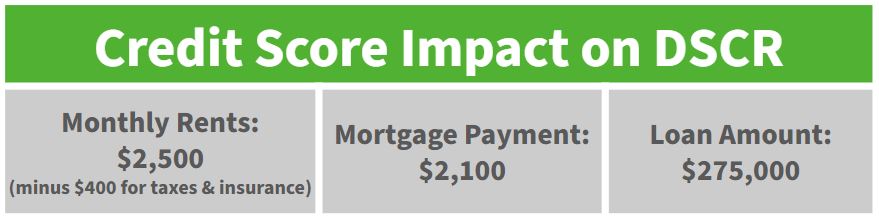
Let’s look at an example to see how credit score can impact your DSCR loans:

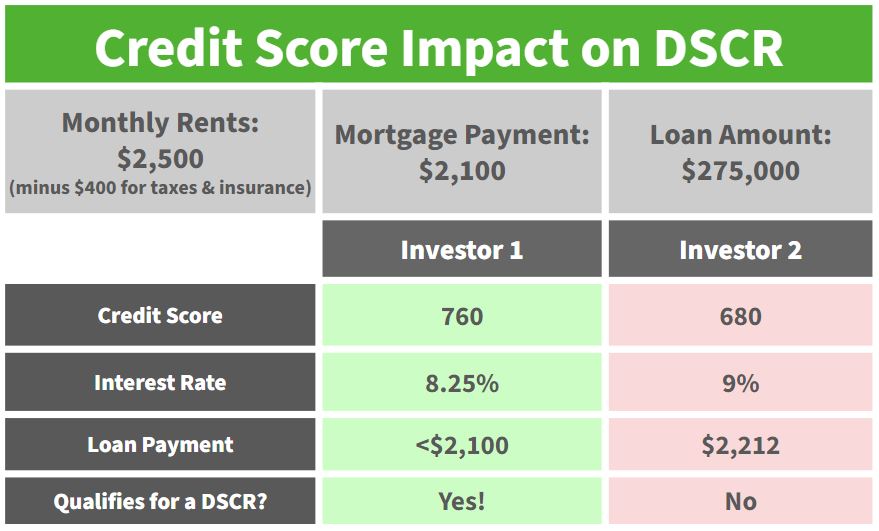
Once you subtract your expenses from the monthly rent, you’re left with $2,100. This means that, in order to maintain a DSCR ratio of 1 (the minimum to break even), you need a loan that has monthly payments of $2,100 or lower.

In the following example, Investor 1 has maintained a high credit score while Investor 2 has dipped below most banks’ minimum requirements.

In the two examples above, everything is the same except for the credit scores, and the effect is significant. Investor 2 can’t get a loan to refinance, and they’re either going to have to sell the property or keep their original loan for far longer than they wanted. 

Regardless, the person with the higher score is able to move through the investing process easily, lucratively, and quickly.

A bad credit score can tank your leverage and sabotage your investing by creating unnecessary roadblocks for your projects. 

How to Fix a Bad Credit Score

In the example above, Investor 2 struggled with a usage issue. This means that, even though they paid off their balance on time every month, excessive use of their personal credit card ended up driving down their score.

Here’s the deal: personal credit cards are not built to handle consistent real estate investing expenses. If you’re doing consistent real estate investing, we recommend looking into business credit cards.

Business cards often have higher usage limits which are ideal for the constant wear and tear of this industry.

You can also look into secured usage loans as a way to quickly boost your credit score.

Main DSCR Loan Takeaways

Leverage is king, and credit scores are an important piece of your leverage.

A good credit score makes it easier for you to qualify for and refinance your DSCRs. They can also help you put less money down on a property and increase your cash flow. 

Take care of your money buckets and credit score on the front end so you can succeed when deals come your way.

To help you get prepared, you can explore our website where we have free tools you can download to help you get organized, including a DSCR calculator and a business credit card marketplace.

If you’re interested in learning more about how you can E.L.F.F. your investing, feel free to reach out to us at Info@TheCashFlowCompany.com or fill out a contact card.

by