Here are your current loan options for a property that isn’t cash flowing.

Our recent blog talked about one course of action when you have a property stuck on the market: selling at a loss.

There comes a point where the loss in a short sale is cheaper than the loss of carry costs for who knows how long while you wait for a better market.

But those aren’t your only two options.

Maybe you want to hold the property, see it through to the next seller’s market, and capture all the equity you know is there. In this case, selling isn’t the right answer. But carry costs still pose a problem.

The answer to the problem? Renting with negative cash flow. 

This brings us to the question at hand: How do you get a loan for a property that isn’t cash flowing? What’s the best way for you to preserve as much money as possible? Let’s talk about what you can do with a property that isn’t cash flowing.

Why You’d Need a Loan for a Property That Isn’t Cash Flowing

No one in their right mind would choose to pay thousands in carry costs on a finished fix-and-flip project. So when you have a flip that won’t sell, it can be appealing to just clear the slate with a short sale.

But what if you want to cash in on the equity in that house? What if you know you just need the right market to finally recoup all these costs…?

This is a common way negative cash flow rentals are born. Losing just $500/month is much better than losing $2,000/month on the same property with no tenants.

Other Reasons to Have No Cash Flow Property

The most typical scenario where you need to figure out what to do with a non-cash-flowing property is when a flip needs to become a rental, and the rents won’t cover the loan payment.

There are a couple other common reasons real estate investors need a negative cash flow loan on their properties:

  • The property can’t be rented yet, so there’s $0 coming in.
  • People want to lock in an interest rate. Although rates are much higher than they were earlier this year, they’re still anticipated to rise another 4 or 5% in the next year or so. Properties that are in a bad spot now will only get worse and worse. Opting for certain, planned payments now over uncertain future ones is choosing the lesser of two evils.
  • If a property has equity but no cash flow, this loan could be used to get money from that equity. We’ve helped people get cash to put back into their real estate investments or business this way.
  • Banks might start calling loans soon. So a new loan for a property that isn’t cash flowing could keep you out of an uncomfortable payoff on the old loan.

Overall, flip owners want to get locked in to a longer-term loan before it’s too late. Banks are tightening more and more. Soon, they’ll turn down loans for properties that don’t cash flow, or refuse to extend their loans.

Working with a property that isn’t cash flowing comes down to one question: How can I get certainty while I wait out the next two or three years?

Most Common Loan Options for Non-Cash-Flowing Properties

There are three main types of loans you can get for a property that doesn’t cash flow: traditional, bridge, or DSCR loans.

Using a Traditional Loan for a Property That Isn’t Cash Flowing

You can still get into a traditional loan in this market for a property that doesn’t cash flow.

This could look like a 30-year fixed Fannie or Freddy, or even a regular bank loan. Many banks are offering, three, five, or seven year fixed products. That term length could get you past the anticipated market downturn, into an environment where rates start improving.

Bridge Loans for No Cash Flow Properties

Bridge loans span just one or two years. These loans are fast, flexible, and easy, but they’ll likely cost you more money.

Additionally, you’ll have to be careful about the length of a bridge loan for your non-cash-flowing property. One or two years isn’t guaranteed to carry you into a time of better interest rates.

No-Ratio DSCR Loans

DSCR loans are designed for properties with rental payments. To use a DSCR loan, you don’t necessarily need to have active rent income on the property. DSCRs can be based off the market rent for the area of the property, rather than the literal rent income.

Requirements for Loans on Negative Cash-Flowing Properties

The mortgage industry is constantly changing, and not to the advantage of borrowers.

If you’re in a situation with a property that isn’t cash-flowing, you want to get locked in somehow – whether with a 30-year product or a 3-year one.

Loan options are changing just about daily – to the detriment of buyers. Credit score requirements are going up, loan-to-values are going down, and rates are steadily rising.

Credit Requirements for Loans

Just as you care about the financial health and responsibility of your tenants, the bank cares about the same for you. The expectations from banks become stricter when money is as tightened like it is now.

Credit requirements specifically have increased. You’ll have a hard time finding any loan at all in this market if your score is below a 680. To get better terms and rates, you’ll have to have a score in the mid-700s.

How Income Impacts Your Real Estate Loan Options

Income is an important part of the underwriting process for any loan, but especially so on a property that isn’t cash flowing. Different types of loans will have different income requirements.

Traditional Loans

Your income matters most if you’re attempting to get a traditional loan or other bank loan. Even if a property is negatively cash flowing, you can still get a traditional loan based on your income. If you make enough money (from a W2 job, other investment properties, etc.), banks will gladly offer you a loan.

As long as your income can cover the property’s costs, then the rent income doesn’t matter so much for a traditional loan.

Bridge and DSCR Loans

Let’s say the property has no or negative cash flow and you don’t have a strong enough income for the banks’ requirements. In that case, a bridge or DSCR loan is a better option for your property that isn’t cash flowing.

Neither a bridge loan nor a DSCR loan rely on your personal (or business) income at all. A DSCR loan typically works based on the ratio of your rent and your expenses, but there are also no-ratio or negative DSCR loans available.

Terms and LTVs on No Cash Flow Real Estate Loans

The length of time, or term, of your loan is important to consider when you have a property that isn’t cash flowing.

Why you need a loan in this circumstance comes down to two reasons:

  1. You need to lock in a loan before the market gets worse.
  2. You need that loan to carry you until the market improves.

LTVs are also important, and will dictate whether or not you can afford this new loan.

Traditional Loans

There are a lot of options for a traditional loan on a property that’s not cash flowing. Some will work better for your property than others.

Many bank terms are between 3- to 7-years fixed, amortized over 20 or 30 years. These loans are useful for non-cash-flowing properties because that three, five, or seven years can bridge you into the next season where rates will come down.

If you can qualify for one of these traditional loans, your maximum potential loan-to-value in this market is 75%. Bank loans will offer the highest LTVs out of all of your real estate loan options in this situation.

Bridge Loans

The term of a bridge loan is typically one or two years. If you know you’ll have an exit after that year or two, bridge loans are a great option.

Bridge loans are easy and fast. However, it’s possible interest rates won’t go down within that 1- to 2-year term, so you may be stuck refinancing into a second bridge loan, or other loan.

Additionally, the LTVs on bridge loans average 60-70% maximum.

DSCR Loans

There are many different types of DSCR loans available, with varying terms.

They traditionally go for 30 years. However, there are other options, including interest-only 40-year or 3- to 7-year fixed loans.

LTVs also take a hit with DSCR loans, averaging around 65-70%. 

Next Steps for Your Property That Isn’t Cash Flowing

If you need a loan for a non-cash-flowing property, see if you can qualify for a traditional loan first. Their high LTVs make them the best, but their income requirements may be tough to meet.

Have any questions about a property with negative cash flow? Looking for a different type of real estate loan? Send us an email at Info@TheCashFlowCompany.com. We’d love to help if we can, or refer you if we can’t.

by

The basics on calculating the paydown payment on the amortization part of an interest-only loan.

There are two parts to an interest-only loan. Part one is just interest, and part two is the paydown, or amortization.

You never have to wait to get to the paydown in order to refinance your interest-only loan. Some investors refinance the same interest-only property over and over before ever getting to the paydown part.

But it’s important to know the numbers even if you don’t want to keep an interest-only loan until the paydown. Here are the basics of calculating 30-year and 40-year interest only loans.


Calculating The Paydown

The interest-only portion of an interest-only loan lasts for a set number of years. For example, let’s say ours lasts 10 years.

The paydown period is when the loan starts amortizing – the actual amount borrowed starts going down. However, you’ll still need to pay normal interest along with the principal payment.

With most lenders, you’ll get either a 30-year or 40-year loan. A 30-year interest-only loan would involve 10 years of just interest, plus 20 years of paydown. For a 40-year, you’d have 30 years’ worth of amortization payments.

A 30-year loan’s payments will be higher because you’re paying the same amount off in a shorter period of time.

Calculating a Paydown Payment Example

Let’s break down the difference between a 30-year and 40-year interest-only loan.

30-year loan = 10 years interest, then 20 years of amortization

40-year loan = 10 years interest, then 30 years amortization

You can use an amortization calculator tool to figure your monthly payments for the paydown period.

Let’s look at an example for a $300,000 interest-only loan. The paydown period payments would be:

30-year =  10 years of $2,000/month + 20 years of $2,509/month

40-year =  10 years of $2,000/month + 30 years of $2,201/month

Remember that you’re never locked into paying a full interest-only loan. An interest-only loan may be worth looking into for your property. Especially if you need a product with lower monthly payments while you wait out rising interest rates.

Help with Interest-Only Loans

Have questions about interest-only loans, or calculating your paydown payment? Is there a deal you’d like us to take a look at?

We search hundreds of loans every month – now is a great time of variety in loan products. We’d love to help you find exactly what you need.

Email us at Info@TheCashFlowCompany.com.

Read the full article here.

Watch the video here:

by

Home prices are decided by what buyers can afford. Here’s how to calculate affordability. 

As an investor, you have to understand where prices are now and where they’ll be in a few months. 

If you buy a property now, then 4 to 6 months from now is when you’ll either be selling as a flip or appraising for refinance.

For medium-priced homes and below, purchases are mainly based on affordability. Interest rates dictate affordability. Affordability dictates the value of homes.

So let’s look at the numbers. We’ll use an example of a homebuyer who can afford a $1,000 monthly payment right now at the end of 2022.

How to Calculate Affordability – The Payment

Affordability is the monthly payment a buyer can afford. This number is determined by:

  • The buyer’s financial comfort.
  • The income and budget of the buyer.
  • And most importantly: the lender’s qualification requirements.

Many buyers would feel comfortable paying a higher monthly amount, but they’re restricted by their lender. Affordability is a major factor in the loan approval process. Buyers in the mid- to low-price range only get approved for one monthly number, regardless of market conditions or property values.

How Affordability Changes Buying Power – The Price

Interest rates are currently at a 7% average. Only being able to afford a $1,000 payment, this buyer could qualify for a $150,000 home. The $150k is their “purchasing power.”

But interest rates are expected to increase to 8% next year. What happens for this buyer then?

When interest rates rise, purchasing power falls. This buyer still only qualifies for a $1,000 payment, but at an 8% rate, they can only afford a $136,000 house.

What if rates rise to a whopping 9%? Buying power for this buyer decreases to $124,000.

A $124,000 house with a $1,000 payment may not be realistic in many markets today. You have to see what the current environment is in your area, and base your numbers on current interest rates and property values.

How Affordability Impacts the Seller

Affordability doesn’t just impact the buyer; it should also change your expectations as a real estate investor. With higher interest rates, affordability will drop. You have to take this into account when you’re buying properties in this market.

If you buy a house right now in the 7% market, you expect it to sell for $150k. However, you need to keep changing interest rates and affordability in mind. In 6 months when you’re ready to sell, interest rates may be at 8% and your list price will sink to $124k.

Each time interest rates rise by 1%, prices drop by a little over 9%. When interest rates go up 2%, there’s a 17.3% drop in values.

Rates when you’re buying matter less to price than rates when you go to sell. You need to anticipate where rates will go. If rates rise 1-2%, you have to account for affordability.

This balancing of affordability and buying power is one of the biggest factors in home pricing. The majority of people buy based on payments and affordability. Their payments are not going to change despite price changes.

Read the full article here.

Watch the video here:

https://youtu.be/-Q_jNTQQzyo

by

Buying low and selling high all comes down to interest rates’ impact on affordability. Here’s what that means.

Building generational wealth with real estate depends on leveraging buyer affordability.

Interest rates and prices work like a seesaw. When interest rates go up, affordability and buying power go down, so prices go down. When interest rates come down, buyers can afford higher payments, so prices re-inflate.

So, where will we be in 2023, and how will prices play out? Interest rates are projected to be 8% – the highest they’ve been in years. Let’s look at an example of this seesaw effect.

Interest Rates’ Impact on Affordability

We’ll use 8% as an example, since that’s the projected average for next year. (But this math will work whether your interest rate is 7%, 10%, etc.).

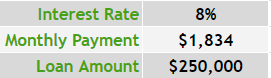
Let’s say our buyer can afford a $250,000 house with an 8% interest rate. We can calculate that their monthly payments would be $1,834.

That monthly payment amount is important. We tend to think of a buyer’s budget as the purchase price they can afford. But really, a buyer’s budget is the monthly payment they can afford.

Even if a buyer is willing to pay a higher purchase price with high interest rates, their lender may stop them. A buyer qualifies for a loan based on the affordability of the monthly payment.

For an interest rate of 8% in 2023, buying power looks like this:

You can plug any numbers you want into this formula to figure out affordability.

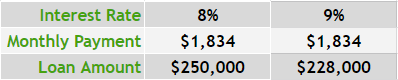
For example, let’s say interest rates are 9%. The affordability doesn’t change – our buyer could still only swing a $1,834/month payment. Therefore, this homebuyer’s buying power goes down to $228,000.

Cash Flow with High Interest Rates

As you can see, the higher the interest rate, the lower the price. This is why you should buy while interest rates are high. 

Prices will be lower than they have in a while. The challenge is that high interest rates make generating cash flow on properties more difficult. However, even if your rental property only breaks even every month – that’s fine for right now. 

A little temporary cash flow loss is worth it when you’re on the path to generational wealth. When interest rates come back down, cash flow will accelerate through the roof.

Let’s flash forward our 2023 example a few years in the future.

Building Equity when Interest Rates Impact Affordability

Say we bought that $250k house at 8% in 2023. Three or four years later, the market has stabilized. More money is flowing in the economy and in real estate, driving interest rates back down. Inflation has calmed down to normal levels. Now, let’s say the average interest rate is down to 5%.

What’s the affordability of that 5% rate with our buyer who could qualify for a $1,834/month payment? Now, they can qualify for a $341,000 house.

That means the house you bought for $250k in 2023 could be worth $341k by 2027. This one property could create $91,000 in equity.

Of course, this isn’t a guaranteed timeline or number. But we know it’s close. Real estate operates with the seesaw of rates and prices, affordability and payments.

Refinancing Once Rates Fall

So you have $91,000 in extra equity. But here’s where the cash flow starts to kick in: You can now refinance the property from an 8% rate to 5%.

Your original loan will be down to about $245,000 after 4 years of $1,834 monthly payments. Refinancing $245k at the new 5% interest rate makes for monthly payments of $1,315.

This refinance would increase your monthly cash flow by $519.

Multiply that by 12 months in a year. By 10 more properties… And you’re on the track to generational wealth.

Read the full article here.

Watch the video here:

https://youtu.be/I5jRjQvHJhk

by

Do you sell at a loss, or wait out the market? Which is right?? Sometimes it’s best to go for certainty in real estate investing.

A real estate horror story:

You buy a big, pricey house in early 2022 for a quick flip. Seven months of carry costs later… It still hasn’t sold, with never-ending price drops, and no profit in sight.

We’ve had a lot of clients in this spot. They have flips on the market that just aren’t selling. They come to us overwhelmed, feeling crazy for paying a constant stream of outflow every month.

The property becomes a giant anchor they’re dragging behind them. They just want to figure out – How do you make it stop??

We have a plan we work through with people in this situation. We call it: “Certainty.”

Let’s walk through an example of how we’ve helped a client create certainty in their real estate investment.

What Is Certainty in Real Estate Investing?

Certainty in real estate investing is about coming up with a conclusion. This conclusion is whatever path:

  • Gets the property somehow moving along.
  • Offers the least out-of-pocket cost for the client.
  • Provides a clean slate to get them back on track to take advantage of the upcoming better market.

Certainty in Real Estate Investing by Taking a Short

In a market like this, you often end up with two options:

  1. Continue paying carry costs, with no sale in sight.
  2. Sell at a loss, for certainty about how much you’ll lose and the freedom to move on.

Taking the first option involves high monthly payments for 6-9 months, or longer. Once the end is finally in sight, it’s possible you’ll find out you’ll have to pay even more and take a huge loss anyway.

With the second option, you accept what the market is giving you. You take the short, then you move on. Money will still be lost, but the timeline of the payouts has a clear end. It becomes certain.

The first option is a gamble with the cards stacked against you. The second option is a clean slate to start fresh.

If you’re trying to find the best route to certainty for your property, we’ll go over some examples. You can follow along with the numbers for your own situation. Running these numbers will help you find out if it’s smart to opt for certainty in your real estate investment.

How to Calculate the Certainty of a Real Estate Investment

One client owed (and were paying interest on) $600,000 for their loan. When they first took out this loan in early 2022, they were expecting to sell the property within a month or two for $800,000+.

This property was supposed to be a quick cleanup – get in, get out, and make a quick couple hundred thousand dollars. Then the market changed, especially for higher price point homes in their area.

Now, five months later, they’re desperate to get out of the property.

What Is the Cost of Certainty?

If sold now in the current market, they could get $570,000.

That’s $230k less than they had originally hoped to get for this property – enough of a gut-punch as-is. But to sell for $30,000 less than you owe on the loan itself? Not ideal.

Although selling right now would mean a $30,000 loss for this client… At least that number is certain.

They’ve already spent close to that much on carry costs alone since purchasing the property. If they can’t get a better price for another several months… Which option is more worth it?

Would you rather lose $30k for sure? Or pay dollar signs with question marks and no end in sight?

How Do You Pay for the Loss?

So, say you’re in this client’s position, and you’ve decided to sell for $570k. How do you go about paying off the remaining $30,000?

 In this specific instance, we as a lender worked flexibly with our client. Since they were already locked into making payments indefinitely, we trusted them to also pay in a definite amount of time. So we put a term on the remaining $30k for the same payment amount.

Now, the client has the property out of their hands and a much smaller loan to pay off. They will make the same payments as they were on the larger loan, and they could pay the full loan off in 5 months and be done with it.

$30,000 isn’t a little money. Five months isn’t a short amount of time. But paying that much for certainty can beat paying 2x or 3x as much for uncertainty in this market.

What If Your Lender Isn’t Flexible?

Most lenders will be open to working something out with you. They want certainty, too. It does them good in the long-term for you to get this property out from over your head.

Opting for a shorter term loan is a great way for a lender to clear the decks and get ready for the next wave of great purchases.

However, even if your lender is unwilling to work out a shorter term, you still have a couple options for paying off the loan when you sell at a loss:

  • Cash – The obvious answer is you pull this cash right out of your own bank account. Not everyone has that luxury (or wants to take that path if they do), so there are a few other options.
  • Private money – In a bind like this, the flexibility of OPM is useful. If you borrow money from family, friends, or people in REI groups in your area, you can pay them back at a rate better than they’d get in the stock market or a bank right now.
  • Gap funding – You could also do a lien on another property to provide some gap funding. If your original lender won’t do this, we can help.
  • Use another lender – If the property’s original lender won’t agree to a short-term loan, someone else might.

How to Calculate the Uncertainty of Real Estate Investing

If you’re deciding whether to sell at a loss or keep fighting in a declining market, the question comes down to whether you want a certain loss or an uncertain loss.

Let’s dig through the numbers to see how much a client of ours was paying every month to keep a property on the market with no in-flow.

How Much Are Carry Costs?

Our client with a $600,000 loan could only sell at $570,000 in the current market.

This is a $30,000 loss. But the number is certain.

Remember their alternative is covering the costs while holding the property for an indefinite period of time. In a market that’s not seeing higher property values for potentially a long time.

The list of costs adding up month after month gets long fast:

  • Mortgage
  • Interest
  • Insurance
  • Taxes
  • Staging
  • Utilities
  • An extension fee if you go too long with your short-term loan
  • And more.

On a $600,000 house, these costs add up rapidly. The market could take 2+ years to get to a point where they can sell for more than $600,000… This client would be losing much more than $30,000. And still, even that is not a promise.

What Does Uncertainty in Real Estate Investing Cost?

Here’s the breakdown for this client’s property’s costs:

  • Mortgage (in this case, interest-only payments): $4,900
  • Taxes: $300
  • Insurance: $200 (Paid up-front for the period of time they thought they’d sell by. That period has passed, so this became a monthly charge.)
  • Staging & Utilities: $325 (Since it was a larger, higher-quality house, they added some furniture and decor to help it sell. Utilities also stayed on while the house was on the market.)

That’s a grand total of $5,725 per month to keep this house on the market. 

This is money that adds no true value to the property. It’s cash flying out of their pockets and getting them nowhere fast.

These costs are a necessary evil in normal real estate investing. The kicker here is that there’s truly no end in sight.

The market is not expected to get better (especially for higher-end properties) for quite some time. In fact, interest rates are actually anticipated to go up.

Interest rates rising just one more point could impact buying power so much that the house’s market value could go down another $50,000.

Uncertainty vs Certainty in Real Estate Investing

Uncertainty: You know you’ll pay $5,725/month. But you have no clue how long.

Certainty: You know you’ll owe $30,000 on the short. But you also know the payments will be done in 5 months.

Uncertainty: You know money will be leaving your investment business, but you don’t know for how long.

Certainty: You know you’ll go into the next market without this property and its almost-$6,000 monthly payment hanging over your head.

Uncertainty: You don’t know what the selling price will be next year. It could be $520k or lower.

Certainty: You know the house could sell for $570k now.

Uncertainty: You don’t know where the market is going. But it’s probably going to be rough for sellers.

Certainty: You know that wherever the market goes from here, better deals are likely to become available for buyers.

Do You Want Certainty or Uncertainty?

Our client took a property that was uncertain, and they found a path with a doable, certain number.

Despite the financial loss, the certain option allowed them more freedom. They knew when the payments would end, and they could plan for the future. 

Property values are anticipated to keep going down. Terrible if you have a bunch of properties sitting on the market eating up your cash flow… but great for buying.

If you have any questions, or want to run through some numbers, we’d love to help. Even if we’re not your lender, we can give you guidance or gap funding.

Send us an email at Info@TheCashFlowCompany.com. For more info on real estate investing in this market, check out our YouTube channel.

by

The BRRRR prepare and prevent: Prepare for your refinance. Prevent a bad investment.

We believe in this quote:

“It is better to prepare and prevent than it is to repair and repent.”

This line applies to all real estate investing, but especially BRRRR. 

The BRRRR Buy Box is a framework designed to help you bring a “prepare and prevent” mindset to your rental investments.

Prepare and Prevent with Your BRRRR Buy Box

The BRRRR Buy Box involves keeping the refinance at the forefront of the process. You need these 4 key pieces of information before ever closing on a property:

  • Cash flow requirement.
  • Money you can put in the property.
  • Required loan amount.
  • Purchase and rehab budget.

Knowing the BRRRR Numbers

If the maximum loan you want to do is $250,000 and you’re willing to put in $30,000, that makes $280,000 total for everything. This “everything” includes the purchase, both closings (for the initial loan and the refinance), all construction costs, and carry costs.

There are a lot of reasons to prepare for BRRRR. Poor prep results in holding the house longer, missing out on vital rent income, and paying high interest rates on a hard money loan.

Before diving into BRRRR, remember:

  • The house can involve major repairs.
  • Your lender could delay the appraisal process.
  • You need to factor closing and carry costs into your total budget.

Don’t give up on BRRRR

Make sure you’re prepared to win at BRRRR. Know your BRRRR Buy Box, and you’ll be successful.

Nine out of the 10 people we meet who stop doing BRRRR give up because they got to the refinance and it just did not work.

These people didn’t prep their buy box ahead of time. Therefore: They had to bring in too much money. The house did not cash flow. They didn’t qualify for a refinance. The hard money loan sat on the house, eating away at their funds.

In this situation, people usually sell at a loss, then they’re turned off from BRRRR forever.

BRRRR is an excellent process. It’s a smart way to get into rentals, if you prevent and prepare before you start buying. 

Download this free BRRRR tool to plug in your numbers and understand your BRRRR Buy Box quickly and easily.

Help to Prepare and Prevent

If you’re left with any questions or have a potential BRRRR deal you want us to look at, we’d be glad to help. We can go through the numbers for you and help you find your BRRRR Buy Box.

Send us an email at Info@TheCashFlowCompany.com.

Read the full article here.

Watch the video here:

by

Will an IO loan really save you money? Find out by calculating the interest-only payment.

There are two parts to an interest-only loan. Part one is just interest, and part two is the paydown, or amortization.

Typically, the interest-only period is 5 or 10 years where your only cost is interest. You aren’t required to pay down the principal at all during that time. So for, say, 10 years, you pay interest, but your loan amount stays the same.

Keep in mind, with an interest-only loan, you always have the option to pay down the principal. These loans typically don’t come with a prepayment fee.

Calculating Interest-Only Payment Example

Find the numbers relevant to your deals, and you can follow along by calculating the interest-only payment. You might need a loan for $500,000, or maybe just $100,000. For our example, we’ll use $300,000 as our loan amount.

The interest-only phase of interest-only DSCR loans uses one simple formula.

First, multiply the loan amount by the interest rate. This gives you the yearly interest. Divide that number by 12 (for the 12 months in a year) to get your monthly payment. The formula looks like this:

Loan Amount x Interest Rate = Yearly Interest

Yearly Interest ÷ 12 = Monthly Interest

We’ll use 8% as our example interest rate. So our equation would be:

$300,000 × .08 = $24,000

$24,000 ÷ 12 = $2,000

As long as you don’t pay down any principal during the interest-only period, your payments will be $2,000/month. This $2,000 goes directly to the bank. Your loan amount will remain $300,000, unless you choose to make an extra payment toward the principal.

Calculating the Interest-Only Payment While Paying Principal

Every time you opt into a principal payment during the interest-only period, your monthly payment changes.

For example, let’s say you pay down $20,000 from your loan, leaving the total loan amount as $280,000. You can re-use the previous formula with this new loan amount to get your new monthly payment:

$280,000 × .08 = $22,400

$22,400 ÷ 12 = $1,866

If you chose to pay down your principal by $20,000, your new monthly payment of interest would be $1,866.

How Annual Interest Works on Interest-Only Loans

Don’t let the idea of “annual” interest trip you up. For these interest-only DSCR loans, interest isn’t calculated once from January to December. Instead, the bank will do this formula each month for your loan using your current principal.

Remember that this interest is your monthly loan payment, but it is not your property’s total monthly expenses. If your loan is a DSCR, you also have to consider taxes, insurance, and HOA fees to know your actual monthly expenses.

Pros of Interest-Only Loans

There are two major advantages of interest-only loans:

  • Cash Flow – Interest-only loans lower your payments, which makes for less money out and more money in. With the interest-only period, you can do deals that would never work with a typical loan payment.
  • Flexible Refinance – You can refinance most interest-only loans at any time (dependent on the lender’s prepay policy). It can be a great strategy to use an interest-only loan for the next four or five years while rates are high. When rates come back down, you can refinance into another loan product that will build equity.

Read the full article here.

Watch the video here:

by

Where is buying power going? How do you determine home prices in 2023?

This is the perfect time to start real estate investing. Great properties are available. …As long as you understand how to price them for the current market.

The good news is, real estate prices aren’t a complete guessing game. Supply, demand, and other circumstances do factor in. Ultimately, however, everything consumers buy is based on affordability, not necessarily price

For example, someone who could afford a $10,000 car could also afford a $30,000 car – as long as the financing worked out to be the same monthly payments.

Let’s go over the simple math of how this idea of affordability affects real estate, especially in 2023.

How to Determine Home Prices in 2023 (and Payments!)

As an investor, you have to understand where prices are now and where they’ll be in a few months. If you buy a property now, 4 to 6 months from now is when you’ll either be selling as a flip or appraising for refinance.

For medium-priced homes and below, purchases are mainly based on affordability. Interest rates dictate affordability. Affordability dictates the value of homes.

So let’s look at the numbers. We’ll use an example of a homebuyer who can afford a $1,000 monthly payment right now at the end of 2022.

Affordability – The Payment

Affordability is the monthly payment a buyer can afford. This number is determined by:

  • The buyer’s financial comfort.
  • The income and budget of the buyer.
  • And most importantly: the lender’s qualification requirements.

Many buyers would feel comfortable paying a higher monthly amount, but they’re restricted by their lender. Affordability is a major factor in the loan approval process. Buyers in the mid- to low-price range only get approved for one monthly number, regardless of market conditions or property values.

Buying Power – The Price

Interest rates are currently at a 7% average. Only being able to afford a $1,000 payment, this buyer could qualify for a $150,000 home. The $150k is their “purchasing power.”

But interest rates are expected to increase to 8% next year. What happens for this buyer then?

When interest rates rise, purchasing power falls. This buyer still only qualifies for a $1,000 payment, but at an 8% rate, they can only afford a $136,000 house.

What if rates rise to a whopping 9%? Buying power for this buyer decreases to $124,000.

A $124,000 house with a $1,000 payment may not be realistic in many markets today. You have to see what the current environment is in your area, and base your numbers on current interest rates and property values.

Affordability and Buying Power Impact the Seller

Affordability doesn’t just impact the buyer; it should also change your expectations as a real estate investor. With higher interest rates, affordability will drop. You have to take this into account when you’re buying properties in this market.

If you buy a house right now in the 7% market, you expect it to sell for $150k. However, you need to keep changing interest rates and affordability in mind. In 6 months when you’re ready to sell, interest rates may be at 8% and your list price will sink to $124k.

Each time interest rates rise by 1%, prices drop by a little over 9%. When interest rates go up 2%, there’s a 17.3% drop in values.

Rates when you’re buying matter less to price than rates when you go to sell. You need to anticipate where rates will go. If rates rise 1-2%, you have to account for affordability.

This balancing of affordability and buying power is one of the biggest factors in home pricing. The majority of people buy based on payments and affordability. Their payments are not going to change despite price changes.

Home Prices in 2023 for a Higher Price Point

To show how affordability and buying power work at any price point, let’s go over an example with a $750,000 property.

If a buyer was looking at a $750k home in 2022 at a 7% interest rate, their payment would be $4,990. Their affordability (the monthly payment they’ve qualified for) is $4,990. So if interest rates change, the home price they can afford will go down.

For example, if rates go to 8%, their buying power drops to $680,000.

At 9%, they can only afford a $620,000 house. 

Make sure you understand where rates are projected to be in the future. The profitability of both flips and rentals are dependent on these rates.

As of right now in late 2022, rates are expected to continually increase – potentially up to 9-10%.

Comparing Home Prices in 2021 – 2023

Knowing past and future interest rates, affordability, and buying power will help you make informed decisions about your next real estate purchase.

For reference, let’s work out some examples of purchasing power for a homebuyer in 2021.

Purchasing Power in 2021 for $1,000 Payment

If we had a buyer who could afford a payment of $1,000 today, they could buy a $150,000 home. 

Just a year ago, buyers could get interest rates at 3% or lower. So in 2021, this buyer would have a purchasing power of $252,000.

That same buyer, in 2023, is anticipated to have a purchasing power of only $124,000.

Purchasing Power in 2021 for $5,000 Payment

If another buyer was going to buy a $750k house in 2022 at a 7% interest rate, what was their purchasing power in 2021?

For the same $5,000 payment, someone in 2021 could afford a $1.2 million house! In 2023, that payment could only get a $620,000 property.

How Purchasing Power Impacts Sellers

As an investor, it’s wise to keep this reality in mind: 

In a matter of two years, someone can go from being able to afford a $1.2 million house to a $600,000 one. 

With no change in income. No change in qualifications. No change in credit score. The only change is how interest rates impact payment.

Although affordability changes so drastically in a short amount of time, mindset does not. People will still expect the quality of their previous higher price point while they’re looking at homes in their current lower price point.

In addition to focusing on the numbers of your flip, you also have to obsess on quality. If buyers don’t see the quality they expect, they’ll either stay in their current home, or find another property on the market that won’t need any fixes.

Buying Now to Sell at the Home Prices in 2023

Going forward in 2022 and 2023, you need to look at affordability. The US buys on payments, so your prices need to be adjusted to buyers’ affordability.

If you have any questions on how to price properties, or have a deal you’d like us to look at, reach out. Email us at Info@HardMoneyMike.com

And be sure to check out our YouTube channel for more information on real estate investing.

by

There are many DSCR loan options – but how do you calculate the ratio for each one?

Some of your DSCR loan options include 30-year fixed mortgages, 40-year fixed, or interest-only. But how do you know which one’s best?

You’ll have to crunch the numbers. Here’s one example of calculating different DSCR loan options on a $200,000 loan with $2,000 rent.

What Is a DSCR?

DSCR means debt service coverage ratio. It’s a loan for rental properties that hinges on cash flow.

A DSCR loan will be a useful product in your real estate investing career. It requires no income verification and no work or investment history. These loans only require that the property’s income is the same (or higher than) the expenses.

Cash flow is always important to you as an investor, and for DSCR loans, it matters just as much to your lender. The better your cash flow, the better LTV and rates you can get. 

It all depends on a little number – the ratio itself. Here’s how to calculate the DSCR with different loan options.

How to Calculate the DSCR

Loan LTVs and rates on a DSCR are determined by the debt service coverage ratio itself. Now that we have all our raw information, we can plug it into our DSCR calculation to get the ratio.

Here’s how you get the numbers you need:

Add up your expenses (taxes, insurance, and HOA fees) with each loan’s payment amount. Then divide rent by all those expenses.

Costs + Mortgage = Total Expenses

Rent ÷ Total Expenses = DSCR Ratio

Here’s an example of what it would look like with an example using a $200,000 loan and an 8% interest rate:

We want the DSCR to at least equal 1.

Over 1 is ideal. This is a higher cash flow, and you’ll get a better loan.

Less than 1 means negative cash flow, and means you might have to look at a negative DSCR or a no-ratio loan instead.

<1 = Negative Cash Flow

At 1 = Rent = Expenses

>1 = Positive cash flow

Read the full article here.

Watch the video here.

by

Fastest route to generational wealth? Buy real estate in 2023.

2023 will be a great time to buy real estate.

When a recession hits, when interest rates are high… that’s where you create generational wealth.

Let’s look at the math and past examples to prove it.

We’ll go through the market mechanics behind buying in 2023. Plus, we’ll review the success our clients had during the last recession (and show how you can do the same).

The Secret Behind Generational Wealth with Real Estate in 2023

Building generational wealth with real estate depends on interest rates. Let’s run through the math of how it all works.

Interest rates and prices work like a seesaw. When interest rates go up, affordability and buying power go down, so prices go down. When interest rates come down, buyers can afford higher payments, so prices re-inflate.

So, where will we be in 2023, and how will prices play out? Interest rates are projected to be 8% – the highest they’ve been in years. Let’s look at an example of this seesaw effect.

Interest Rate vs Price When Buying Real Estate in 2023

We’ll use 8% as an example, since that’s the projected average for next year. (But this math will work whether your interest rate is 7%, 10%, etc.).

Let’s say our buyer can afford a $250,000 house with an 8% interest rate. We can calculate that their monthly payments would be $1,834.

That monthly payment amount is important. We tend to think of a buyer’s budget as the purchase price they can afford. But really, a buyer’s budget is the monthly payment they can afford.

Even if a buyer is willing to pay a higher purchase price with high interest rates, their lender may stop them. A buyer qualifies for a loan based on the affordability of the monthly payment.

For an interest rate of 8% in 2023, buying power looks like this:

You can plug any numbers you want into this formula to figure out affordability.

For example, let’s say interest rates are 9%. The affordability doesn’t change – our buyer could still only swing a $1,834/month payment. Therefore, this homebuyer’s buying power goes down to $228,000.

Cash Flow with High Interest Rates

As you can see, the higher the interest rate, the lower the price. This is why you should buy while interest rates are high. 

Prices will be lower than they have in a while. The challenge is that high interest rates make generating cash flow on properties more difficult. However, even if your rental property only breaks even every month – that’s fine for right now. 

A little temporary cash flow loss is worth it when you’re on the path to generational wealth. When interest rates come back down, cash flow will accelerate through the roof.

Let’s flash forward our 2023 example a few years in the future.

Building Equity with Real Estate in 2023

Say we bought that $250k house at 8% in 2023. Three or four years later, the market has stabilized. More money is flowing in the economy and in real estate, driving interest rates back down. Inflation has calmed down to normal levels. Now, let’s say the average interest rate is down to 5%.

What’s the affordability of that 5% rate with our buyer who could qualify for a $1,834/month payment? Now, they can qualify for a $341,000 house.

That means the house you bought for $250k in 2023 could be worth $341k by 2027. This one property could create $91,000 in equity.

Of course, this isn’t a guaranteed timeline or number. But we know it’s close. Real estate operates with the seesaw of rates and prices, affordability and payments.

Refinancing Once Rates Fall

So you have $91,000 in extra equity. But here’s where the cash flow starts to kick in: You can now refinance the property from an 8% rate to 5%.

Your original loan will be down to about $245,000 after 4 years of $1,834 monthly payments. Refinancing $245k at the new 5% interest rate makes for monthly payments of $1,315.

This refinance would increase your monthly cash flow by $519.

Multiply that by 12 months in a year. By 10 more properties… And you’re on the track to generational wealth.

Generational Wealth from the Last Recession

The true “secret” to generational wealth is buying at the right time, then… letting the market take care of itself.

Let’s map out the possibilities if you buy properties while interest is high and prices low, then wait.

Past Client Success

Back in 2010, we helped two families who were particularly successful buy 10 properties each using the BRRRR method.

After 12 years, each of the properties they purchased in 2010 either tripled or quadrupled in value. The rents tripled.

This worked because they bought smart and played the waiting game. They purchased with high rates and low prices, then refinanced once the rates flipped low and values high.

Your Future Success

Let’s say you buy 10 properties in 2023 while rates are high and prices low. Then you hold until the market flips for you – low rates and high values.

You can capture $90k-$100k in equity when the market flips back. Ten properties would add almost $1 million to your net worth.

When you add an extra $500/month in cash flow through a well-timed refinance, that makes for an extra $6,000 in your pocket per year. Multiplied by 10 properties? $60k/year.

All this – just for buying when no one else is buying. Buying when rates are high, values are low, and letting the market correct itself. 

Your Plan to Buy Real Estate in 2023

Buying low with high interest rates, waiting, and pulling in the generational wealth. It’s possible with real estate in 2023.

Want to build a game plan for kickstarting your generational wealth next year? Have a deal now you want us to run the numbers on? Send us an email at Info@TheCashFlowCompany.com.

by