For your real estate investments, do you need credit? Does it matter between business vs corporate credit?

We highly recommend that real estate investors use a business credit card for their projects’ expenses.

They save your personal credit score, and you can get some types of cards for 0% interest rates for at least the first year. You can’t beat that low of a rate!

To be clear, however, we’re talking about business credit cards, not corporate credit. Why does that distinction matter?

How Corporate Credit Differs from Business Credit

Corporate credit is next-level and will take some time to obtain. But if you are interested, here is the link.

The major difference between corporate and business credit is how they decide you’re qualified.

  • Business credit is based on your personal credit score. It requires you to personally sign on the debt.
  • Corporate credit is based on your Dun & Bradstreet score. It does not require you to personally guarantee the debt.

Corporate debt takes time and typically does not start with (or get to the point of) issuing credit cards… Especially to us small companies.

Why You Should Use a Business Card in Real Estate Investing

If you use credit in investing, a business credit card is what you need. It accomplishes two big items for funding:

  1. It keeps business purchases from impacting your personal score. Then, your credit score doesn’t negatively impact your other funding.
  2. It won’t show up on your report for lenders to officially count it against you when calculating your debt ratio.

Business credit cards keep debt from impacting your personal funding options.

How Hard Is It to Get Business Credit vs Corporate?

Assuming you have everything you need to get a business card, including a high credit score, a business or sole proprietorship, and a good, non-real-estate related business name, getting a credit card is relatively straightforward. 

Go to a site like bankrate.com or Credit Karma to pick the card that’s best for you. You can also visit Nav’s list of business cards to compare different types.

If you keep balances, then you may want to look at cards with 0% intro rates. You can change them out every year and save a lot of money.

How to Get Business Credit

If you need to set up a business or improve your credit score, reach out to us at The Cash Flow Company. We have ways to help raise your credit score fast, and can guide you in setting up a business.

You can also check out Fund & Grow. Ask us about the discounts they gave us to pass on to you!
by

Here’s why OPM is the fastest, cheapest, best real estate funding source.

OPM refers to money you find from ordinary people, such as friends, family, or anyone in your investment network.

Ordinary People’s Money can fund any real estate deal – whether it’s just the down payment, the carry cost, the whole purchase price and rehab, or a long-term hold. 

The beauty of OPM is you can fund projects a phone call. Let’s look at why OPM is the best real estate funding source.

The Sheer Power of OPM

Fourteen years ago, we didn’t know anyone who could fund deals for us. We had no hedge fund backing us. We had no black book that gave us all the knowledge and tips.

So we figured out how to find OPM for our company. Fourteen years later, we’ve funded thousands of transactions and hundreds of millions of dollars with OPM.

We’ve done it on a larger scale, but we know that you can do it for your investment business too. With our experience using OPM in real estate, we’re happy to walk you through the process. 

Why OPM Is The Best Real Estate Lending Source

OPM is arguably the best lending source out there.

Unlike traditional lenders, OPM does not require:

  • a credit check
  • income verification
  • appraisal
  • extensive paperwork

The terms of the loan are also flexible to fit your specific needs. This could include carrying the interest, a longer or shorter term, or a first or second position. Additionally, OPM loans often come with fewer fees, such as points, processing, and underwriting.

OPM could be all or part of a project’s funding. It could cover:

  • down payment
  • carry cost
  • long-term hold
  • short-term flip

Any project you have, any money you need, you can find it with OPM. And best of all, it’s a partnership where you both win.

Read the full article here.

Watch the video here:

https://youtu.be/Jym-GhdhtoU

by

If you have bad personal credit, can you still get a business credit card?

As a real estate, you may be wondering how to get a business credit card and what sort of credit you need.

It can be challenging to secure credit when your personal credit score is less than ideal, but it’s not impossible. In this post, we’ll explore some tips and strategies for getting a business credit card with bad personal credit.

Personal Credit is Key to Business Credit Card Success

First, it’s important to understand that you’ll need a good credit score to get business credit cards. A credit score of at least 700 is usually the minimum requirement, with higher scores providing access to larger limits and more card options.

Assuming you have everything you need to get a business card, including a high credit score, a business or sole proprietorship, and a good, non-real-estate related business name, getting a credit card is relatively straightforward. 

Go to a site like bankrate.com or Credit Karma to pick the card that’s best for you. You can also visit Nav’s list of business cards to compare different types.

If you keep balances, then you may want to look at cards with 0% intro rates. You can change them out every year and save a lot of money.

Business vs Corporate Lines

It’s worth noting that business credit cards and personal lines of credit are different from corporate credit.

Business credit is typically based on your personal credit score and requires you to personally sign on the debt. 

Corporate credit, on the other hand, is based on your Dun and Bradstreet score and does not require you to personally guarantee the debt. Obtaining corporate credit can be a longer process, and it’s not common for small companies to obtain credit at the corporate level.

Resources for Business Setup and Credit Boosting

If you need to set up a business or improve your credit score, reach out to us at The Cash Flow Company. We have ways to help raise your credit score fast, and can guide you in setting up a business.

You can also check out Fund & Grow. Ask us about the discounts they gave us to pass on to you!

by

How can credit cards help real estate investments? Here are 3 ways to use 0% cards.

Business credit cards with 0% rates can be a great entry point for new investors. Unsecured credit can fill the gaps left by your primary loan.

But how is a credit card supposed to help on a real estate investment? Let’s go through 3 ways you can use it.

1. Reserves or Down Payment on Credit Cards for Real Estate

If you have unsecured lines, or even 0% credit cards, and move the money over to accounts, then you could use those funds as reserves or a down payment.

The more money you can put in as a down payment, the better your rate, terms, and cash flow will be. Maybe funds from a credit card could allow you to put 10% rather than 5% down. This change could lower your interest rate by 1-2%.

Lenders give better rates to lower loan-to-value deals – especially for bridge loans. Take advantage of this by using unsecured credit to get more money.

2. Saving Money on Interest

Typical interest rates on credit cards are around 19-29%.

Say you put $25,000 on a 24% credit card for an investment project. Over the course of a year, that’s about $6,000 in interest. Multiply that by however many projects you complete in a year, and the costs add up fast.

0% business credit cards just make sense. With these, you can pay $0 in interest for your first year or two, rather than an astronomically high 29%.

3. Protecting Your Credit Score

When you use credit cards on your personal account, the usage negatively affects your credit score. You can’t get great loans from banks and private lenders with a bad credit score.

These 0% credit cards and other unsecured lines should be put under your business name, not your personal name. When you use an LLC, this credit usage comes off your personal credit report.

Read the full article here.

Watch the video here:

https://youtu.be/REkxzKoe6kw

by

Using a business credit card changes your RE career. Here’s how to get one.

Real estate investors should think of their investment projects as a business. And a huge step in propelling your business forward is to get a business credit card.

A card for your business can solve some major credit-related problems. Here’s what you need to get one.

What You Need to Get a Business Credit Card

There are three main things you need before you can get a good credit card with an easy process. You need good credit, a business, and a generic business name:

  • Good personal credit. The higher your score, the better your options are for card terms.
  • A business. (A sole proprietorship counts). The longer you’ve been in business, the better. But bare minimum, it will need to be a couple months old and have a bank account.
  • A generic name. Additionally, the process will be smoother if the business’s name doesn’t sound like a real estate or lending company.

How to Get One

Do you have the credit, the business, and the right name? If so, then getting a business credit card for real estate is easy.

Go to a site like bankrate.com or Credit Karma to pick the card that’s best for you. You can also visit Nav’s list of business cards to compare different types. Fund & Grow also has some great options you could look into.

If you keep balances, then you may want to look at cards with 0% intro rates. You can change them out every year and save a lot of money.

Once you stop putting your projects’ expenses on your personal card, your credit will be more free for investment opportunities.

Need Help Setting Up a Business Card?

Not sure how to set up a business? Don’t have the right credit to open a card? Reach out to us – we have solutions to fix this quickly.

And lastly, you can also check out Fund & Grow. Ask us about the discounts they gave us to pass on to you!
by

Here’s how business credit cards for real estate investors impact your credit.

You rack up business expenses on your personal credit card for your real estate investing business, and now… Your credit score is too low to get more loans to keep your real estate investing business going.

What’s the answer to this dilemma? Business credit cards for real estate investors.

Personal Credit vs Business Loans

A lower credit score makes it harder to obtain the loans you need in your personal life, such as:

  • Car loans
  • Home loans
  • Student loans
  • Credit cards
  • Boat loans

But your personal credit doesn’t only impact your personal loans. It also impacts the loans you get for your real estate business – which are based on your personal credit score. Whether or not you can get a loan, or how good the terms of the loan is, depend on your credit score.

You need credit cards to keep your real estate projects and business going. What you don’t need, however, is that credit usage driving down your personal score and costing you tens of thousands to hundreds of thousands of extra interest over the years.

What Do Business Credit Cards Do For the Real Estate Investor?

Business credit cards can help solve this problem of usage.

Business credit cards for real estate investors remove your balances from your personal credit, fixing the problem created by the need to use the cards for your projects.

These cards don’t show up on your personal credit, so they don’t drive down your score or get counted against your debt ratios for new loans.

Your business expenses become business debt when put on a business card.

Getting a Business Credit Card as an Investor

Using a business credit card as an investor gives you the benefit of using a card, making accounting easier and not negatively impacting your personal score.

If your investing career is a business, you should be working to obtain a business credit card. Reach out to us to ask how to get started.

And for more credit score tips, check out these videos.

by

What does ordinary people’s money mean? And how do you get OPM for real estate investments?

Real estate investing has two main parts: the money side and the property side. While finding a good property to invest in is essential, securing funding can often be the most challenging part of the process. 

That’s where OPM (what we call Ordinary People’s Money) comes in. OPM is the “holy grail” of funding real estate projects, making real estate investing faster, easier, and cheaper.

Let’s go over what you need to know about this type of OPM in real estate.

What Is OPM?

OPM refers to money that you find from ordinary people, such as friends, family, or anyone in your investment network. 

Ordinary People’s Money can fund any real estate deal – whether it’s just the down payment, the carry cost, the whole purchase price and rehab, or a long-term hold. 

The beauty of OPM is projects can get funded with a phone call. These people are your family members, friends, someone from an investment group.

The Sheer Power of OPM

Fourteen years ago, we didn’t know anyone who could fund deals for us. We had no hedge fund backing us. We had no black book that gave us all the knowledge and tips.

So we figured out how to find OPM for our company. Fourteen years later, we’ve funded thousands of transactions and hundreds of millions of dollars with OPM.

We’ve done it on a larger scale, but we know that you can do it for your investment business too. With our experience using OPM in real estate, we’re happy to walk you through the process. 

Why OPM Is The Best Real Estate Lending Source

OPM is arguably the best lending source out there.

Unlike traditional lenders, OPM does not require:

  • a credit check
  • income verification
  • appraisal
  • extensive paperwork

The terms of the loan are also flexible to fit your specific needs. This could include carrying the interest, a longer or shorter term, or a first or second position. Additionally, OPM loans often come with fewer fees, such as points, processing, and underwriting.

OPM could be all or part of a project’s funding. It could cover:

  • down payment
  • carry cost
  • long-term hold
  • short-term flip

Any project you have, any money you need, you can find it with OPM. And best of all, it’s a partnership where you both win.

Why Would Someone Want to Be an OPM Real Estate Lender?

Part of why OPM in real estate works so well is because it’s a win-win.

Your lender gets a better return on their money than many other investment methods, for zero work.

You’re paying them a (lower than institutional funding) rate of interest. Especially with the economy as unpredictable as it is right now, people who have cash want a stable place to put it with a consistent return. Becoming an OPM real estate lender offers just that.

In addition to a stable rate, OPM investors also get to invest in their community. Rather than putting money in stocks, national banks, or huge funds, they get to support a small business like you.

Finding OPM for Real Estate

Reach out at Info@TheCashFlowCompany.com, and we can show you exactly how to find OPM real estate lenders.

What we can’t help you do is keep them – that part is up to you. When you find an OPM lender, make sure to take care of them, get them their returns on time, and be honest throughout the process.

A good lender will either stick with you for the long haul or disappear after the first deal, and it all depends on how easy you are to work with.

Other Resources for OPM & Real Estate Investing

It doesn’t matter if you’re experienced or a novice. OPM should be in everyone’s money bucket.

For more info on getting OPM, download this free checklist. For more on real estate funding and strategy, check out the videos on our YouTube channel.

by

What’s a usage loan? And how does it raise your credit score?

Your credit card usage is reported to the three credit bureaus.

This impacts your FICO score.

Your FICO score impacts the funding and terms you can get for your real estate investments.

So what is a usage loan? Where does it come into all this?

Why Usage Matters

If you pay off your card balances before the next reporting cycle (before your next statement), then your FICO score will rise.

Disclaimer: your score will go up as long as everything else stays the same. As long as you have not taken out other credit, missed a payment, or created over negative credit issues, lowering your usage will have a 

But if you had the cash laying around to pay off these balances, you probably would have done it awhile ago. How do you bring your usage down without cash? That’s where a usage loan comes in.

What Is a Usage Loan?

It’s a loan that makes life easier and more profitable for you.

A loan to correct the usage that negatively impacts your credit score and limits your access to GOOD leverage.

More specifically, it’s a private loan that does not report to your credit bureau that you can use to pay down your credit cards, thus increasing your credit score.

It tips the lending guidelines back in your favor AND gets you better, cheaper, and easier loans.

How to Get a Usage Loan

A usage loan isn’t meant to deceive your lender. You still have to let lenders know you have this debt.

If your debt was on a business card where they belong, it wouldn’t count against your personal credit. What a usage loan does is give your credit score a leg-up to get you the best funding you deserve. 

Interested in discussing a usage loan? Let us know here.

For more info on getting credit ready for leverage, you can watch these videos.

by

Great deals are starting to pop up… But here’s how real estate financing could affect them.

Lenders used to fill your “money bucket” 90% or more for a project.

The current market, however, is giving us 80% at best.

What else is the current market giving us? Great deals. The type of deals real estate investors wait years to find.

You’ll need to organize financing so you can close on these deals… You need to fill your money bucket. Here are the basics.

What’s Your Bucket for Real Estate Financing?

Your money bucket is empty at the start of a project. Its size is determined by the costs. For successful investments, you need to fill up the bucket with money.

The financial term for filling the bucket is a “capital stack.” It’s when an investor stacks one loan on top of another until an entire project is funded to 100%. Let’s go over how to put your capital stack, or “money bucket” together.

How Big Is Your Bucket?

If we’re just starting a deal, then our money bucket is empty. Firstly, we need to know: how big is it? AKA, what costs do we need to cover?

There are four main costs in real estate investing:

  • Purchase price
  • Rehab
  • Carry costs
  • Interest payments and other miscellaneous

How Much Does Current Real Estate Financing Fill Your Money Bucket?

We need to see if we can fill our money bucket, so we start looking for other buckets of money to throw in. We begin with the loan from our primary lender.

In a typical market, a real estate investment lender (like hard money) would pay 75% of the ARV of the property. That 75% would cover 90% of the purchase price and 100% of the rehab costs.

With tightened money, however, the underwriting guidelines for this bucket have changed. Almost universally, you’ll see these same lenders only offering 70% of the ARV. This adds up to 80% on the purchase and 100% on the rehab. You’re getting less financing for real estate projects, so you’ll have to bring in more money out-of-pocket for this deal.

That’s not an insignificant amount of money, either. Down payments now, in early 2023, are sometimes double what they were six months ago.

You need gap funding to fill your money bucket. Get these great deals that won’t wait!

Want to build your capital stack? Download our free resource on money buckets.

Read the full article here.

Watch the video here:

by

Ease of funding makes real estate investing easy or hard. Here are 4 ways bad credit impacts loans.

In our 20+ year history in the lending world, we continually see credit usage as the #1 thing keeping real estate investors from obtaining the best funding possible.

Credit is the main reason funding is granted or denied. To win this game, you need to understand this and work to put yourself in the best position to succeed.

Let’s go over 4 ways that bad credit impacts loans and what you need to succeed.

The 4 Ways Bad Credit Impacts Loans

The 4 most negative potential impacts due to low credit scores for real estate investors are:

  1. Being denied a loan (so you can’t purchase or refinance a property)
  2. Cash flow takes a hit with higher rates, around 1-4%
  3. Higher closing costs, around .5 to 2%
  4. Being required to put more money down on a property (lower LTV on loans)

Let’s dive in to what each of these means for an investor.

1. Bank Turn Down

If lenders won’t lend to you, then it’s almost impossible to invest and make money. No loan, no property – no property, no investing.

Sometimes this means no one will lend to you with bad credit. Other times, you can squeeze in, but pay more than your competitor.

2. Paying Higher Interest Rates

Paying higher rates brings a lot of setbacks.

With a bad credit score, you might need to go to a different type of lender who will charge more. If not that, then you’ll at least be dropped to a lower lending tier (ie, higher interest rate) with the cheaper lender.

In any case, you’ll feel the hit of higher rates in your cash flow.

To show this, here’s an example of a 2.5% difference in rate on a $300,000 mortgage:

  • Rate of 6.25% = monthly payment of $1,847.15
  • Rate of 8.75% = monthly payment of $2,360.10

An investor with a 680 score might get the 8.75% rate. Another investor with a 780 could get closer to 6.25%. That’s over $500 more per month one investor pays versus the other.

More money means more you can re-invest. Another example of why it is easier to succeed with better funding.

3. Paying Higher Fees

Almost every lender has pricing tiers. These tiers are usually tied to credit scores in some way.

The lower the score, the higher the cost of the loan. With bad credit, some lenders jack up the rate and others jack up the fees.

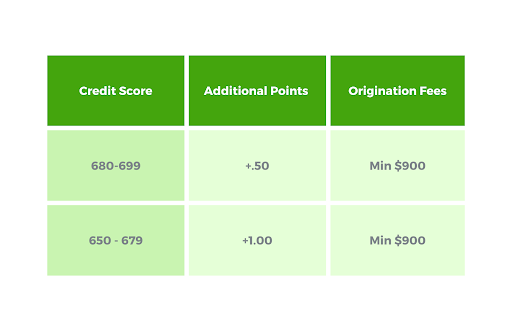
These fees typically come in tiers similar to this one from a bridge lender:

In this example, on a $300,000 loan, you will pay an extra $1,500 to $3,000 more than your competitor with great credit for the same loan.

4. Lower LTV Funding

Credit score is the main reason some investors can get away with only putting 10% (or even 0%) into a project while others have to bring in up to 25%.

In our $300,000 property example:

  • At 10% down, you bring in $30,000
  • At 25% down, you bring in $75,000

That extra $45,000 could keep you out of deals and or limit the number of deals you could have going at a time.

Keep Bad Credit from Impacting Loans

Overall, we need funding to succeed in real estate. The cheaper, easier, and faster it is, the more opportunities and success it creates. Bad credit impacts the loans you can get for your investments.

Check out these other tips to quickly raise your credit score on our YouTube channel.

You can also send us an email anytime with questions about your credit and real estate investing loans at Info@TheCashFlowCompany.com.

by