Tag Archive for: other people’s money

Never Run Out of Money!

Categories: , ,

Real estate investing is not just about finding good deals. Instead, it is about making sure you have the money to finish those deals quickly and profitably. Unfortunately, many investors learn this lesson the hard way. They buy a property, start the rehab, and then suddenly run short on cash. As a result, projects slow down, contractors leave, carrying costs grow, and profits disappear. That is why learning How to Build a Real Estate Funding Stack And Never Run Out of Money! can completely change your investing business. A strong funding stack helps you move faster, solve problems quicker, and protect your profits from expensive delays. More importantly, it gives you confidence before you even buy the property.

In this guide, we will break down how smart investors build multiple layers of funding using tools like hard money loans, HELOCs, business credit cards, private money, and cash reserves. Along the way, you will also learn why speed matters so much in real estate investing and how proper funding can help you create a smoother, more profitable business.

What Is a Real Estate Funding Stack?

Most new real estate investors think funding means getting a loan. However, that is only part of the picture. The truth is simple. A lender may help you buy the property and fund part of the rehab. Still, the rest of the project is on you.

That is where many investors get stuck. They run out of money halfway through the deal. Then, projects slow down. Contractors leave. Materials get delayed. Interest payments pile up. Finally, profits disappear.

On the other hand, investors with a strong funding stack move faster, stay calmer, and make more money. A real estate funding stack is simply a group of money sources working together. Instead of relying on one loan, smart investors build layers of funding.

For example, your funding stack may include cash, HELOCs, business credit cards, private money, lines of credit, hard money loans, and funding partners. Together, these tools help you cover everything the lender does not. As a result, you can keep projects moving without stress.

Why Most Investors Run Out of Money

Most investors only focus on two numbers: the purchase price and rehab costs. Unfortunately, real projects cost much more than that. Investors also need money for closing costs, insurance, appraisals, interest payments, utility bills, material deposits, contractor payments, surprise repairs, escrow gaps, and holding costs.

Because of this, many investors get trapped halfway through the project. In fact, many flips that should take 4 to 6 months end up taking a year or longer. Then, every extra month eats away profits.

Many investors find this out after their first project. At first, the deal may look profitable on paper. However, delays change everything. One delay leads to another. Then, profits slowly disappear while expenses continue to grow.

Every Delay Costs You Money

Here is the problem many investors do not see at first. Hard money loans usually have interest-only payments. Therefore, every month you hold the property costs money.

Let’s say your monthly carrying costs are around $2,800 per month between loan payments, taxes, insurance, and utilities. Now imagine your project gets delayed by three months because you did not have enough money for windows, flooring, or HVAC work. Suddenly, that delay costs you more than $8,000.

Meanwhile, the investor with proper funding finishes early and moves on to the next deal. That is why speed matters so much in real estate investing. The faster you move from close to close, the faster you protect your profits.

The Goal Is Funding Certainty

Great investors do not wait until they need money. Instead, they build funding certainty before they buy the property. They know where every dollar will come from. They also know how they will handle surprise costs and keep projects moving.

As a result, they protect their profits and reduce stress during the project. We always say, “The money is in the buy, but you protect your profits with the funding.”

Funding certainty gives investors confidence. Instead of scrambling for money during the rehab, they stay focused on finishing the project quickly and correctly.

Step 1: Start With Your Main Project Loan

First, most investors begin with a hard money loan, bridge loan, or private lender. Typically, lenders may offer up to 75% of ARV, up to 90% of the purchase, and up to 100% of the rehab. However, that does not mean the lender covers everything.

For example, let’s say a property has a $300,000 ARV. The purchase price is $160,000 and the rehab budget is $60,000. A lender may fund 90% of the purchase and all of the rehab. Even then, the investor still needs to bring money into the deal.

That gap catches many new investors off guard. They think “100% financing” means no money needed. In reality, investors still need funds for closing costs, escrow gaps, interest payments, and surprises.

Step 2: Add Your “Money Buckets”

Next, you need backup money buckets. These buckets protect your project when real-life problems show up. Because trust me, they always show up.

Cash reserves help with earnest money, small repairs, utilities, and quick contractor payments. Even a small reserve can keep projects moving smoother.

HELOCs can become one of the best tools for investors because they provide fast access to liquid money. Many investors use HELOCs for down payments, escrow gaps, material purchases, carry costs, and surprise repairs.

Business credit cards can also help bridge short-term expenses. Investors often use them for flooring, paint, appliances, tools, and material deposits. Even better, many business cards offer travel points, cash back, or rewards while giving investors a short float before interest begins.

Private money can help investors scale even faster. In many cases, private lenders help cover down payments, closing costs, carry costs, or emergency overruns. More importantly, private money may help investors avoid expensive delays.

Step 3: Plan For Escrow Gaps

This is where many new investors struggle. Most lenders reimburse rehab money after work gets completed. That means investors may need to pay contractors and buy materials before the lender sends money back.

For example, you may need to buy windows today, install them next week, and wait for reimbursement later. So, if you cannot float those costs, the project slows down immediately.

Because of this, many experienced investors try to keep 30% to 40% of the rehab budget available. That creates speed. And speed creates profits.

Step 4: Build a Contingency Fund

Every project has surprises. Always. Maybe you find bad wiring, roof damage, old plumbing, HVAC problems, or hidden water damage once walls get opened up.

Therefore, smart investors build in a contingency fund before the project starts. A common target is around 10% of the rehab budget. This money protects investors from panic decisions and project delays.

Without a contingency fund, even a small surprise can stop progress for weeks. On the other hand, investors with available funds can solve problems quickly and keep moving.

Step 5: Use the Lowest-Cost Money First

Not all money costs the same. Therefore, smart investors stack funding in the correct order. Usually, investors start with cash first, then HELOCs, then business lines or business credit cards, followed by private money or higher-cost funding if needed.

This lowers total borrowing costs. More importantly, it protects profits over the life of the project. Investors who understand the cost of money usually keep more of their profits at the end of the deal.

A Simple Funding Stack Example

Here is what a simple beginner funding stack may look like. Imagine an investor has $5,000 in cash savings, $15,000 available on business credit cards, and a $75,000 HELOC. Combined with a hard money loan, that investor now has flexibility and speed.

As a result, contractors get paid faster, materials get ordered faster, and delays shrink. At the same time, stress drops while profits improve. That is the power of a strong funding stack.

Why Proper Funding Creates Better Deals

Many investors think profits only come from buying cheap properties. That is only partly true. The real money also comes from faster project completion, lower holding costs, better contractor relationships, bulk material discounts, and avoiding expensive delays.

Therefore, better funding often creates bigger profits than finding a slightly better deal. Investors who move quickly usually save money at every stage of the project.

The Best Investors Think Ahead

The best investors do not scramble for money halfway through a project. Instead, they prepare before they buy. They build systems. They create funding certainty. And they protect their profits with available money.

That is how real estate investing becomes less stressful and more profitable. Investors who prepare ahead of time usually sleep better and scale faster.

Final Thoughts: Build Your Funding Stack Before You Need It

If you want to grow in real estate investing, do not wait until a project goes bad to figure out your funding. Instead, build your money buckets early, create backup funding, keep liquid funds available, and plan for delays before they happen.

Remember, the goal is not just getting the deal. The real goal is finishing the deal fast, smoothly, and profitably. Because investors who control funding usually control the profits too.

Learn How to Build a Real Estate Funding Stack And Never Run Out of Money!Watch my most recent video today to find out more!

by

Fix and Flips: What They Really Cost (And What You Actually Make)

Most new real estate investors believe 100% financing means one lender covers the whole project. However, that is usually not true. In reality, “The 100% Financing System Every Fix & Flipper Needs” is not one loan. Instead, it is a full system built to cover every part of the project from purchase to sale.

In most fix-and-flip deals, the lender may fund 80% to 90% of the purchase price and 100% of the rehab costs. At first, that sounds like everything is covered. Still, there are many other costs investors forget to plan for.

For example, investors still need money for closing costs, insurance, monthly payments, utilities, contractor deposits, and surprise repairs. In addition, many projects run into escrow gaps where work must get completed before the lender releases funds. Because of that, investors often need extra available money just to keep the project moving.

That is why true 100% financing is really about building a funding stack. The best investors understand this early. As a result, they finish projects faster, avoid delays, and protect more profit along the way.

What True 100% Financing Really Means

True 100% financing means having access to every dollar needed from the day you close until the day you sell or refinance the property. In other words, the project never slows down because of money problems.

Let’s look at a simple example. Imagine you buy a property for $150,000 and plan a $50,000 rehab. Most people think they only need $200,000 to complete the project. However, that number misses many real-world costs.

You still need to plan for:

  • Closing costs
  • Carry costs
  • Insurance
  • Utility bills
  • Escrow gaps
  • Contractor payments
  • Repair overruns
  • Appliances
  • Landscaping
  • Holding costs

Because of that, experienced investors often plan for about 120% of the purchase and rehab budget. Therefore, a $200,000 project may really need about $240,000 available to keep everything running smoothly.

That extra money protects the deal. More importantly, it protects your timeline.

Why Speed Matters So Much in Fix and Flips

In real estate investing, speed creates profit. On the other hand, delays destroy profit very quickly.

Every extra month costs money. Loan payments continue. Insurance continues. Utilities continue. Taxes continue. Meanwhile, contractors may leave for other jobs if they are not paid on time.

For example, one investor may have all the funds ready before the project begins. Their contractor stays busy, materials arrive on time, and the home gets listed in six weeks. Another investor may spend months trying to piece together funding during the project. As a result, contractors stop showing up, projects slow down, and profits shrink month after month.

Many investors do not realize how much delays cost until it is too late. A project delayed by four to six months can easily lose tens of thousands of dollars in payments, holding costs, and missed market opportunities. That is why proper funding is not just about buying properties. It is about protecting profits by moving fast.

The Biggest Mistake New Flippers Make

Many new investors focus only on finding a cheap property. While buying right matters, funding matters just as much. A great deal with poor funding can still become a bad investment.

For example, some investors buy a property first and then try to figure out the rest later. They use personal credit cards, borrow small amounts from friends, or wait for escrow draws before paying contractors. Unfortunately, this usually creates stress and delays.

Instead, smart investors build the funding system first. Then they buy the property knowing they can finish the project quickly and safely. That confidence changes everything. It helps investors make better decisions, move faster, and avoid panic during the rehab process.

The 100% Financing System Explained

The best investors use multiple “money buckets” to create true 100% financing. Each money bucket serves a different purpose. Together, they help keep projects moving from start to finish.

The first bucket is usually the main fix-and-flip loan. This loan often covers most of the purchase price along with the rehab costs. However, the loan rarely covers everything else needed during the project.

That is where the additional funding buckets come in.

Many investors use HELOCs, business lines of credit, or personal lines of credit to fill the gaps. These tools help cover closing costs, contractor deposits, escrow gaps, and unexpected repairs. The nice part is you only pay interest when you use the money. Therefore, these lines can sit available in the background until needed.

Business credit cards can also help when used correctly. Investors often use them for materials, small project costs, and short-term expenses. In addition, some business cards offer rewards, cash back, or travel points. More importantly, many business cards do not report balances to personal credit. As a result, investors can protect their credit scores while still keeping projects moving.

Why Private Money Can Change Everything

Another powerful funding bucket is real private money. This simply means borrowing from real people instead of traditional banks.

For example, some people have savings accounts or retirement funds earning very little interest. Meanwhile, investors may need short-term project funding. Therefore, private money can create a win for both sides when the deal is structured correctly.

Many successful investors build relationships with people who want better returns without actively managing rental properties or flips themselves. These relationships can become one of the strongest parts of a long-term investing business.

Of course, private money still requires responsibility. Investors must run their numbers carefully and make sure the deal works before borrowing funds. Good funding supports a good deal. However, no funding system can save a bad project.

Real Estate Investing Is a Business

One of the biggest mindset shifts for new investors is understanding that real estate investing is a real business. Businesses need systems, reserves, planning, and available capital.

That is why experienced investors prepare before they buy their next deal. They build their lines of credit early, improve their business credit, and create relationships with lenders and private money partners. Most importantly, they make sure they have enough available funds to handle surprises without slowing the project down.

The goal is not endless debt. Instead, the goal is smart funding that helps projects move quickly and profitably. Then, once the property sells or refinances, the investor pays off the lines, cards, and short-term funding used during the project.

That is how successful investors continue growing without getting trapped by debt.

The Real Goal of the 100% Financing System

The real goal of the 100% financing system is simple. Investors want to complete projects faster, reduce stress, and protect profits.

When funding is ready ahead of time, projects move smoother. Contractors stay busy. Materials arrive faster. Escrow delays become smaller problems instead of full project shutdowns.

Most importantly, investors stop operating from fear. Instead, they gain clarity and confidence because they know their funding system can support the deal from beginning to end.

In fix-and-flip investing, time truly is money. Therefore, the investors who prepare their funding first often create the biggest long-term success.

Watch my most recent video to find out more about: The 100% Financing System Every Fix & Flipper Needs

by

Funding strategies for PadSplits

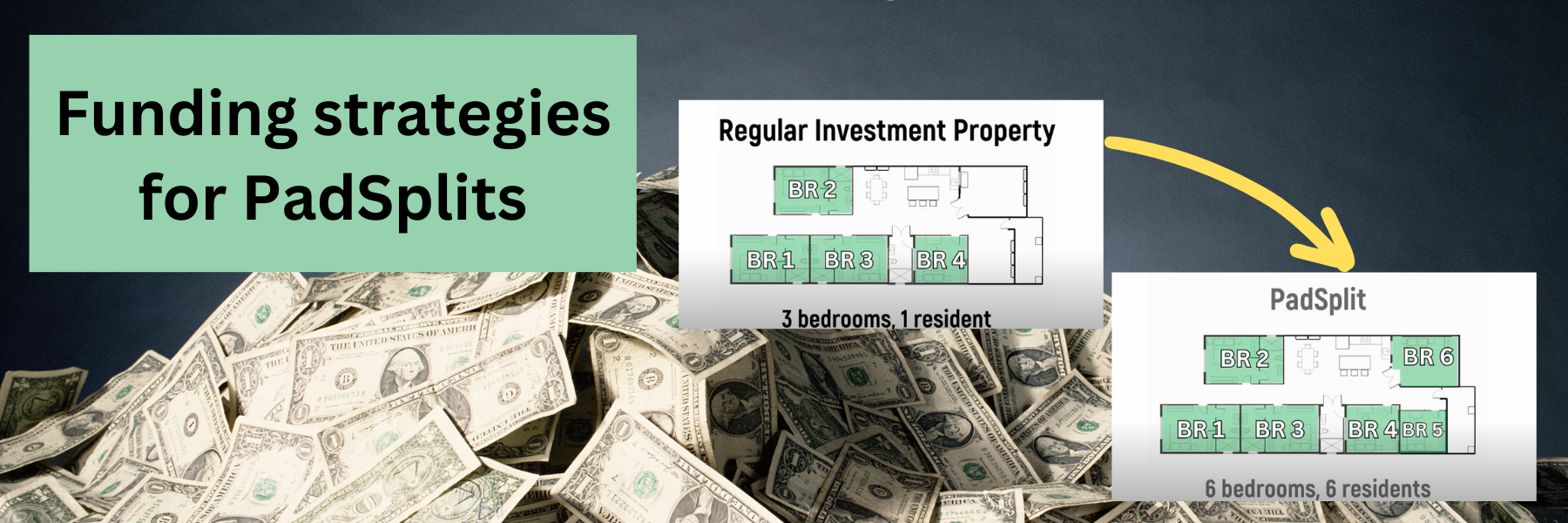
Today we are going to discuss some funding strategies for PadSplits. PadSplits are something that will be growing more and more popular in the near future due to affordability. Creating a PadSplit property will double and even triple your income off of a property.  How can you fund a PadSplit? Let’s take a closer look! 

What is a PadSplit?

A PadSplit takes a regular house that is a 3 bedroom/1 resident, and converting it. The property will then have 6 to 8 bedrooms/6 to 8 residents. To clarify, individuals rent the property by the bedroom as opposed to renting the whole house. These bedrooms are a suite and would have a private bathroom attached. Only the kitchen is a shared space. Each bedroom can then be rented by the week, month, or year depending on individual needs. A PadSplit property creates an affordable property for investors because they get 2 to 3 times the rent for the same property.

How do you finance a PadSplit?

PadSplits are a newer concept in real estate investing. That means that they are new to the lending community as well. Investors need to approach this strategically to get the funding they need to be successful. Right now there is a more limited market for PadSplits, however, down the road, it will become a more common. Here at The Cash Flow Company we receive a lot of inquiries regarding PadSplits and the financing options that are available. Let’s take a look at some of the options that are available for pad splits.

  1. The most important thing that you need to do is to get it funded before splitting it up. Get the property locked into a 30 year loan before dividing it into multiple units.
  2. There are also options under commercial for DSCR that could be used for PadSplits. These options are continuing to grow and there will be more available in the next few months.
  3. If you are looking for a refinance and you already have a PadSplit it is important that you have 12 months of experience and can show the numbers from bank statements or PNL from your company. This would allow us to use the income from the property to refinance the property

Is a PadSplit right for you?

We are here to help answer your questions regarding PadSplits and run through the numbers with you to see if it’s right for you. If you do it right and make your payments, you will have the opportunity to make a lot of money! Contact us today to find out more and get in before everyone else does! 

Watch our most recent video to find out more about Funding strategies for PadSplits.

by

Always Have Enough Money for Your Real Estate Investments

Real estate investors always need to have enough money for their investments. It is important that they see every deal or transaction as a bucket of money. If you are buying a fix and flip or a rental property, there is a bucket of money that is needed. These funds can be used to purchase the property, complete rehab projects, cover closing costs, and take care of the interest. While the majority is going to come from the lenders, the remaining portion is going to have to come from you for a down payment or to cover the interest costs. It is important that you take everything into consideration when you are setting things up in order to win in the real estate game.

What do you need to look at when setting things up?

  1. Make sure that the lenders who are lending you money will give you more at a better price.
  2. Make sure that you have your bucket of money to not only qualify for this loan or multiple loans. Determine what represents your bucket of money, and how you can set it up to play in the game.

What if you don’t have any money going in?

There are many investors who enter the game without establishing their buckets of money. For these investors, it becomes a matter of creativity and how they feel about what they’re doing. There are a lot of people who don’t have anything coming into a deal. For these individuals, they can use lines of credit, or credit cards to do down payments. 

There is always another way to find the funds you need!

One of the most important things to do when you’re starting out is to use other people’s money. Often this is from family and friends. However, it doesn’t have to be. There are a lot of people out there who are looking for better returns. Take a moment to consider if there is someone out there who you can borrow $10K from. Perhaps someone from your real estate group or even a neighbor down the street. By doing this, you can fill your bucket of money with someone else’s money in order to get the return you want. As long as you use the funds correctly, then you can in turn make the money you need in order to pay them back. 

Let’s look at the numbers.

When you are purchasing a property, you can have the bank lend you up to 80% to 90%. The remaining 10% to 20% can then be provided by someone who is looking for a better return. By paying them 10%, it will be a lot cheaper than making payments on a credit card or a loan. The person lending you the money directly will in turn get a better return than they would find elsewhere. It’s a win win on both sides.

What do you need for success?

First and foremost you need to have confidence in order to succeed! If you are going to go out and ask people for money, then you need to show them that it will be a good deal for them. You can show confidence by knowing your project and by developing a business plan that showcases your investment goals. Once they have faith that you will find good properties, fix them, sell them, and make money, then they will partner with you. If you get one person in, then it’s easier to get more later.

We can help you!

We have developed a good system of how to not only find other people’s money, but more importantly how to talk to them about joining you in your investment journey. Here at The Cash Flow Company, we help to find you the leverage you need, get your buckets of money set up, and ensure that the properties you find are good deals. Remember, confidence comes with a good project, finding good projects will then help you make more money. Creating leverage now will help you jump into a deal quickly while others are scrambling. 

Contact us to find out more!

Watch our most recent video to make sure that you Always Have Enough Money for Your Real Estate Investments

by

2024 Housing Market Predictions: Why You Should Invest

The question on every real estate investor’s mind is why you should invest in 2024 with the higher interest rates. There are a few things that people need to consider before investing in this market. This includes shopping wisely, evaluating repair costs, current interest rates, property location, and funding. By considering all of the factors before jumping in, real estate investors can increase their cash flow for future investments. 

Let’s take a closer look at the three things real estate investors need to consider when purchasing a property

First, Focus on the Lower End of the Market 

Since interest rates are high, you should probably focus on the lower end of the market. This includes homes that are in the $300K range and below. Affordability will be a factor when you’re flipping, because someone has to be able to afford to buy the property once repairs are completed. Thankfully, we have a good inventory shortage as investors, which in turn is creating a greater demand. Therefore, if you have a good price point and a good product, then it’s going to sell quickly. 

Second, Create a Product that People will want to Buy

Especially since you will be the one fixing up the property, it is important that you create a property people will want to buy. As real estate investors, it is crucial that you complete repairs both quickly and correctly in order to maximize your investment. By creating a nice fixed up property in this market, you will have an advantage over those who are not putting in the effort. 

Third, Consider the Impact that Interest Rates will have on your investment.

Interest rates will be a major factor when purchasing a property in this current market. However, if you can find a rental property that can break even, or better yet one that can make a little money, you should invest now to generate cash flow quickly. Interest rates should go down in the next 18 months to 2 years. When they do, you will be able to refinance and come out ahead of everyone who has been sitting on the sidelines.

Now is the time to jump in! Let’s take a look at how the market has changed and what you should avoid as you move forward.

How has the market changed?

It is the perfect time to jump in if you can buy something low. As long as you do it correctly, you should invest now while everyone is running away! Then when rates go back down, you will be able to create wealth for future investments. A few years ago many people were buying properties for $100K over asking price. In today’s market  they would be able to sell it for maybe $250K. Since they overpaid on the property a few years ago, they are now upside down on their investment. Don’t let this happen to you! As a new buyer, make sure you are purchasing it at a good number while the market is down. Over time you are going to win the game by buying at the right time.

What should you Avoid?

Getting into real estate investing now will get you on the fast track to success. If you are able to buy good properties in good markets, then you will be successful. It is important to avoid properties that are on corners or busy streets. In these times, the best properties are on a culdesac or near local parks. Real estate investors need to research current market trends before jumping in. There are some markets where cities are doing better than suburbs, while others are growing at a faster rate. Another thing to be aware of as a real estate investor is all of the negativity out there, which is driving people out of the market. Instead of following the herd, turn this negativity around so it can benefit you.There are better deals now than there were a few years ago. This is because people are fearful and want to get rid of properties before things get worse. As long as the sellers have that fear, then investors who are level headed can benefit. 

Number of Real Estate Investors is Shrinking 

There has been a whole generation of real estate investors who have gone through good times with money, banks, and lenders in the past. This was when everyone was trying to give you more money for your investments. However, the Fed is now trying to slow that down. The huge pool has gotten a little bit smaller for those who are trying to qualify for loans. This lending squeeze has resulted in many real estate investors getting out because they don’t have the credit score or income to succeed in this market. In 2024 there will be less real estate investors, less money available for funding projects, but more deals available for the driven investor.

In Conclusion

Now is the time you should invest in real estate properties! By strategically selecting properties, investors have the opportunity to grow their wealth when rates drop. If you are coming in as a new investor, it is important to make sure that you are set yourself up for success. By increasing the amount of money you bring in, and filling your liquidity buckets, you will stand out to lenders. Real estate investing is all about using other people’s money to create wealth with a little bit of your own money. By considering all of the factors and creating a plan, real estate investors will have the potential to increase their cash flow for future investments.

Watch our most recent video to find out more about investing in today’s market.

We can help you get set up to win in 2024! Contact us today!

by

The pros and cons of using other people’s money in real estate investing.

When we say real private money, we’re not talking about companies who’ve just changed their name from “hard money lender” to “private money lender.”

We’re talking about real people. Actual individuals who want to lend you money on a real estate transaction. Real money that’s cheaper, easier, and faster than any funding you could get from an institution.

Let’s go over how other people’s money can be used to fund your transactions, plus the pros and cons.

How Does Other People’s Money Work?

Real private money is the ultimate flexible funding for your real estate investments. Once you have a relationship with a lender, funding a deal is as simple as calling them with a closing timeline and the amount you need.

Remember, we’re not talking about big Wall Street companies that call themselves private money lenders. These types of lenders have strict guidelines and an underwriting process. They have a box you have to fit in.

With real other people’s money, there is no box. You create all the terms.

Depending on the individual OPM lender, you can get small gap loans, or large loans for an entire project. Other people’s money can be short-term, long-term; down payments, carry costs; the options are limitless.

Benefits of Real Private Money

In addition to the total flexibility of other people’s money, here are some other benefits to this style of funding:

  • It’s great for beginners. You don’t need experience, and you don’t need the qualifications required by most traditional lenders.
  • No (or limited) red tape. They won’t check your credit score, income, tax returns, or require an application.
  • It’s cheaper. There are almost never fees, and the interest rates are comparable to a bank’s (on the lower end for financing).
  • You can close quickly. You don’t have to wait for an appraisal to happen or for an application to be processed. Funding is a phone call away.
  • Do any deal. OPM lenders won’t have a box for you to fit in. As long as they get their return, most people could care less what type of property you invest in.

Why Would Someone Lend You Money?

Is it too good to be true? Why would a random person want to give you their money?

The thing about using real other people’s money is it’s an easy win-win scenario.

People with a lot of cash are always looking for a good place to put it, but:

  • Most people don’t want to be in charge of their own real estate investments.
  • Banks have a very low rate of return.
  • The stock market is unpredictable. (A good source of real OPM is older individuals who are nearing retirement. Stocks give a good rate of return in the long term, but when someone plans on retiring soon, they’ll be looking for shorter-term stability).

These people are looking for you as much as you’re looking for them. It’s just a matter of attracting (and keeping!) the right people.

Downsides of Other People’s Money

So, what are the cons to using real private money? There are plenty of positives, but it’s wise to be aware of some potential trouble spots:

  • It’s harder to find lenders. You can’t walk into a bank to get this kind of money; you just have to find the right individuals. Your OPM lenders don’t necessarily have to be millionaires, but they do have to have a good chunk of free money available for you. It can take time to find these people.
  • Keeping OPM lenders can be difficult. It’s takes a lot of time and attention to nurture your real private money lenders. You need to keep their money secure, pay them on time, and provide them with good opportunities. It’s best to have multiple OPM lenders available to you.
  • Finding other people’s money means selling the people on it. People who would most benefit from being a private lender might not even know what it means. If a doctor, dentist, teacher, etc is keeping their life savings in a bank account or IRA, then they might get a better return doing private lending. However, people outside of real estate might not understand how it works. It’s your job to explain how their money gets secured and how the process works.

The funding itself may be easier, faster, and cheaper, but with private money, finding and managing a relationship with a lender can be the hard part.

Just remember that anyone with money is looking for a stable return. If you can prove you’ll provide that, funding opportunities will start rolling in.

How to Get Other People’s Money

So how does the process work once you find other people’s money?

If you need help finding, attracting, convincing, or setting up an OPM lender, let us know. For the last 15+ years, we’ve raised millions and millions of dollars through OPM. Send us an email at Info@TheCashFlowCompany.com with any questions.

Want some more information right away? Download this real private money checklist for free. You can also check out the videos on our YouTube channel.

by